Many international students feel confused when they hear about CPT and OPT. These terms often come up when you want to work in the United States during or after your studies. You may ask, “Can I work now?” or “Should I wait?” This is where the difference between CPT and OPT becomes important.
Both CPT and OPT allow students to gain work experience. But they are not the same. They have different rules, timing, and benefits. Many students mix them up and make mistakes. That can cause problems with their visa.
In this guide, you will learn everything in a very simple way. You will understand what CPT and OPT mean, how they work, and which one is better for you.
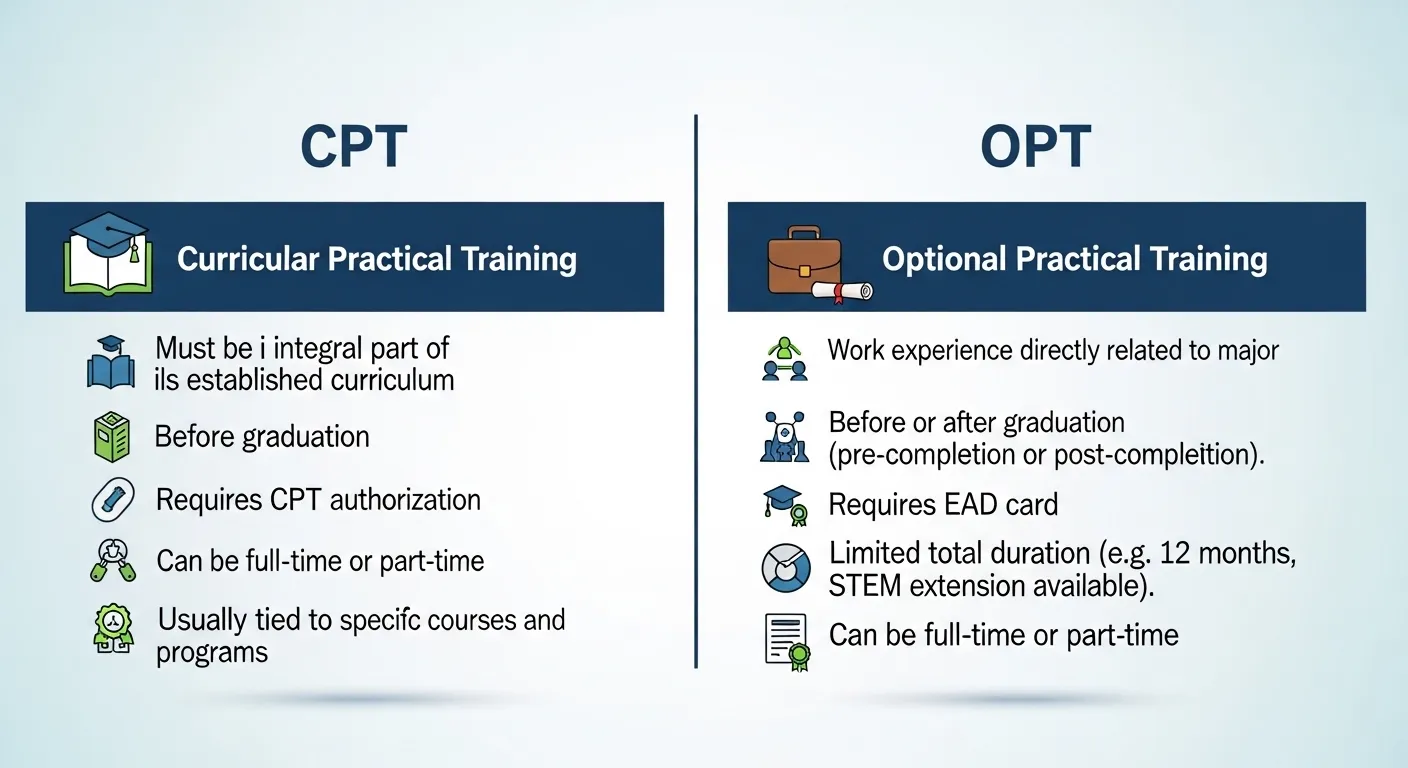
The main difference between CPT and OPT is timing and purpose. CPT is used while you are still studying, and it is part of your course. OPT is used after or near the end of your studies and helps you gain real work experience.
What Is CPT?
CPT stands for Curricular Practical Training.
It is a type of work permission for students in the United States. You can use CPT while you are still studying.
CPT must be related to your course. It is part of your education. Many schools require internships or training. CPT allows you to do that.
You must have a job offer before you apply for CPT. Your school must approve it.
Simple Example:
Ali is studying business. His course requires an internship. He gets a job at a company. He uses CPT to work during his semester.
What Is OPT?
OPT stands for Optional Practical Training.
It is also a work permit for students. But it is mostly used after finishing your studies.
Your course does not require OPT. It is optional. You use it to gain work experience in your field.
You can work for up to 12 months. Some students in STEM fields can get extra time.
Simple Example:
Sara finishes her degree in computer science. She applies for OPT. She gets a job at a tech company and starts working full-time.
Difference Between CPT and OPT
Here is a simple table to understand CPT vs OPT:
| Feature | CPT | OPT |
| Full Name | Curricular Practical Training | Optional Practical Training |
| Timing | During study | Depends on the course |
| Purpose | After or near end of the study | Work experience |
| Job Offer Needed | Yes | No (can apply first) |
| Approval | School approves | Government approves |
| Duration | After or near the end of the study | Up to 12 months |
| Work Type | Internship or training | Any job in your field |
| Flexibility | Limited | More flexible |
| Start Time | Quick | Takes longer |
Key Differences Explained
Timing
CPT is used while you are studying.
OPT is usually used after you finish your degree.
Example:
If you are in your second year, you can use CPT. After graduation, you use OPT.
Purpose
CPT is part of your course.
OPT is for real-world work experience.
Example:
CPT may be required by your school. OPT is your personal choice.
Approval Process
CPT is approved by your school.
OPT is approved by the U.S. government.
Example:
CPT is faster because your school handles it. OPT takes more time because you apply to immigration services.
Job Offer
You need a job before applying for CPT.
For OPT, you can apply first and find a job later.
Example:
With CPT, no job means no application. With OPT, you have more time to search.
Work Flexibility
CPT is limited to specific work.
OPT allows more freedom.
Example:
CPT job must match your course strictly. OPT gives more options in your field.
Examples
Let’s look at real-life situations.
Example 1: During Study
Ahmed is studying engineering. His program requires training. He finds an internship in Lahore with a US-based company branch. He uses CPT to work part-time.
Example 2: After Graduation
Fatima finishes her degree in marketing. She moves to New York. She uses OPT to work full-time at a marketing firm.
Example 3: Part-Time vs Full-Time
With CPT, you may work part-time during classes.
With OPT, you can work full-time after graduation.
Importance of Knowing the Difference
Understanding the difference between CPT and OPT is very important.
It helps you follow the rules. It keeps your visa safe.
If you use the wrong option, you may face problems. You may lose your legal status.
It also helps you plan your career better.
You can decide when to work and how to gain experience.
Students who understand CPT and OPT make smarter choices.
Benefits of Understanding CPT vs OPT
- Helps you choose the right work option
- Saves time and avoids mistakes
- Keep your visa safe
- Helps you plan your career path
- Makes job search easier
- Builds better work experience
- Reduces stress and confusion
Common Mistakes People Make
Many students make simple mistakes.
Mistake 1: Thinking CPT and OPT are the same
They are different in timing and purpose.
Mistake 2: Using CPT without a course need
CPT must be part of your study.
Mistake 3: Applying late for OPT
OPT takes time. Apply early.
Mistake 4: Not checking rules
Each school may have slightly different CPT rules.
Mistake 5: Ignoring job relevance
Both CPT and OPT jobs must match your field.
Real-Life Use
CPT is used during your studies.
Students use it for internships, training, or part-time jobs.
OPT is used after studies.
Students use it for full-time jobs and career growth.
Who Uses CPT?
- Students with internship requirements
- Students wanting early experience
Who Uses OPT?
- Graduates
- Students seeking full-time jobs
When to Choose What?
- Choose CPT during study
- Choose OPT after graduation
Easy Trick to Remember the Difference
Here is a simple trick:
CPT = Course Time
(It happens during your course)
OPT = After Study Option
(It comes after your study)
This trick helps you remember fast.
Which One Is Better?
There is no single winner.
Both CPT and OPT are useful.
It depends on your need.
- Choose CPT if your course requires training
- Choose CPT if you want early experience
- Choose OPT if you want a full-time job after studying
- Choose OPT if you want more flexibility
Most students use both.
They use CPT first, then OPT later.
FAQs
1. What is the main difference between CPT and OPT?
CPT is used during the study as part of your course. OPT is used after or near the end of your studies for work experience.
2. Which is better, CPT or OPT?
Both are useful. CPT is good during study. OPT is better after graduation.
3. Can I use both CPT and OPT?
Yes, many students use CPT first and then OPT after finishing their degree.
4. Do I need a job for CPT?
Yes, you must have a job offer before applying for CPT.
5. Do I need a job for OPT?
No, you can apply first and search for a job later.
6. Is CPT faster than OPT?
Yes, CPT is faster because your school approves it. OPT takes more time.
7. Why do students confuse CPT and OPT?
They both allow work and sound similar. But their timing and purpose are different.
Conclusion
Understanding the difference between CPT and OPT is very important for international students. Both options help you gain work experience, but they are used at different times. CPT is used during your studies and is part of your course. OPT is used after your studies and gives you more freedom to work.
If you plan wisely, you can use both in the best way. Start with CPT for early experience. Then move to OPT for full-time work after graduation. This simple plan can help you grow your career step by step.
Always follow the rules and check with your school. When you understand CPT vs OPT clearly, you make better decisions and build a strong future.