Imagine you’re planning to build a modern web application. You have a great idea, a talented team, and ambitious goals. But then comes the big question: React or Angular?
This is one of the most common debates in web development. A startup founder wants a fast and flexible solution. An enterprise company needs scalability and structure. Developers want tools that are easy to learn and productive to use.
If you’ve searched for the difference between React and Angular, you’re not alone. Thousands of developers, students, and business owners compare these two technologies every month to determine which one best fits their projects.
In this guide, you’ll learn how React and Angular differ, their strengths and weaknesses, real-world use cases, and which one is the right choice for your next project.
Quick Answer
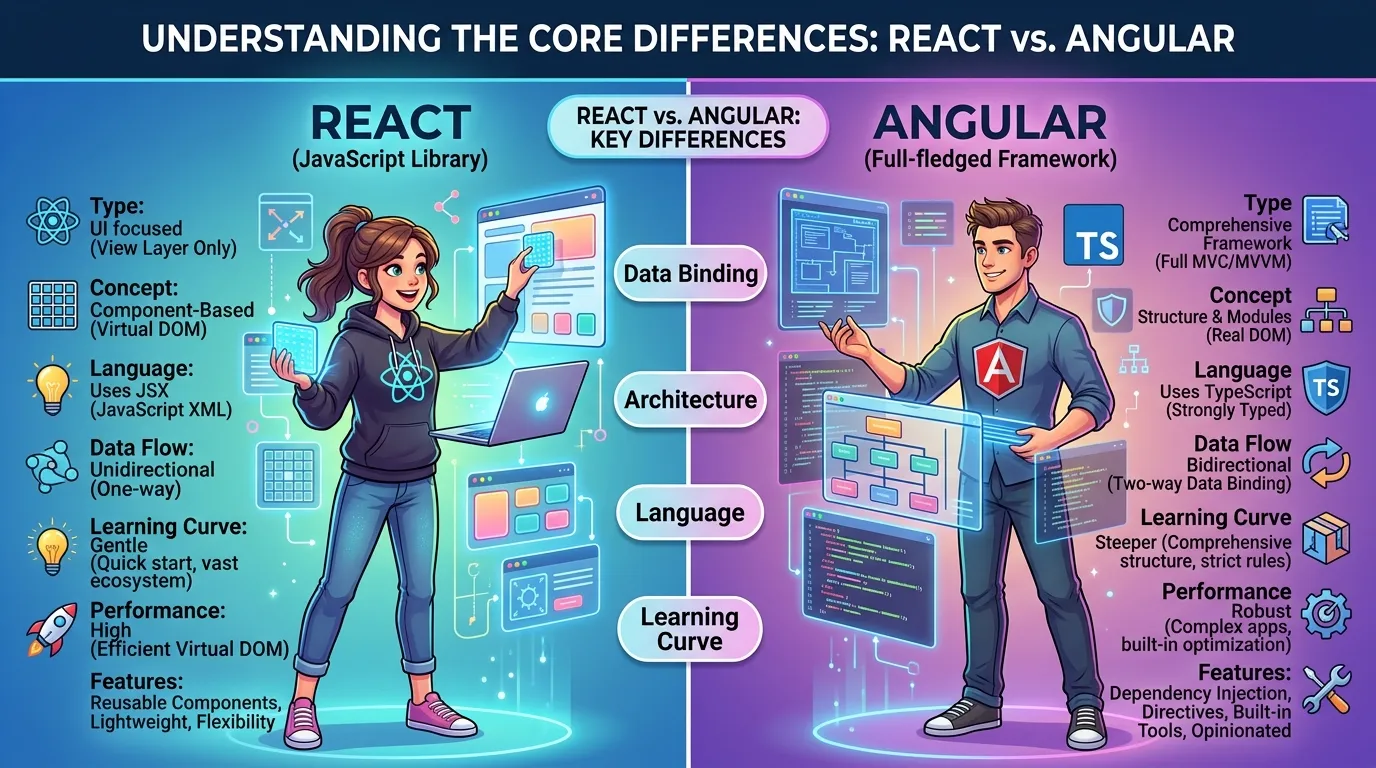
The main difference between React and Angular is that React is a JavaScript library focused on building user interfaces, while Angular is a complete frontend framework that provides built-in tools for routing, state management, forms, and more.
React offers greater flexibility and a gentler learning curve, whereas Angular provides a structured, enterprise-ready development environment.
React vs Angular: Comparison Table
| Feature | React | Angular |
|---|---|---|
| Type | Library | Full Framework |
| Developed By | Meta (Facebook) | |
| Initial Release | 2013 | 2016 (Angular 2+) |
| Programming Language | JavaScript / TypeScript | TypeScript |
| Learning Curve | Easier | Steeper |
| DOM Handling | Virtual DOM | Real DOM with Change Detection |
| Flexibility | High | Moderate |
| Built-in Features | Limited | Extensive |
| State Management | External Libraries | Built-in Solutions |
| Mobile Development | React Native | Ionic/NativeScript |
| Community Size | Massive | Large |
| Enterprise Suitability | Excellent | Excellent |
| Performance | Very Fast | Fast |
| Popularity | Higher | Strong Enterprise Presence |
What Is React?
React is an open-source JavaScript library created by Meta for building interactive user interfaces.
Rather than being a complete framework, React focuses specifically on the UI layer of an application. Developers can choose additional libraries for routing, state management, API handling, and testing.
Key Features of React
- Component-based architecture
- Virtual DOM for fast rendering
- One-way data binding
- Huge ecosystem
- Strong community support
- React Native for mobile apps
Popular Companies Using React
- Netflix
- Airbnb
- Uber
- WhatsApp Web
React has become one of the most popular frontend technologies worldwide because of its flexibility and performance.
What Is Angular?
Angular is a comprehensive frontend framework developed and maintained by Google.
Unlike React, Angular provides nearly everything developers need out of the box. This includes routing, dependency injection, form handling, HTTP services, testing tools, and more.
Key Features of Angular
- Complete framework
- TypeScript-first development
- Dependency injection
- Two-way data binding
- Built-in routing
- Powerful CLI tools
- Enterprise-grade architecture
Popular Companies Using Angular
- Microsoft
- Deutsche Bank
- Forbes
- Upwork
- Samsung
Angular is often favored by large organizations building complex applications that require consistency and long-term maintainability.
Difference Between React and Angular: Detailed Comparison
1. Learning Curve
One of the first things developers consider is how easy the technology is to learn.
React
React focuses primarily on UI development. Once you understand components, props, state, and hooks, you can start building applications relatively quickly.
Angular
Angular requires learning:
- TypeScript
- Components
- Services
- Dependency Injection
- RxJS
- Directives
- Modules
As a result, Angular typically takes longer to master.
Winner: React
2. Architecture and Flexibility
React
React follows a minimalist philosophy.
You decide which libraries to use for:
- Routing
- State management
- API requests
- Form handling
This flexibility allows teams to customize their technology stack.
Angular
Angular follows an opinionated structure.
Google provides predefined solutions for the most common development needs.
This leads to greater consistency across large teams.
Winner: Depends on project requirements
3. Performance
Performance is often a major factor when comparing frontend technologies.
React Performance
React uses a Virtual DOM.
Instead of updating the entire page, React updates only the changed components, resulting in faster rendering.
Angular Performance
Angular uses efficient change detection mechanisms and compilation techniques.
Modern Angular versions have significantly improved performance compared to earlier releases.
Real-World Performance
For most business applications, users won’t notice a significant difference.
The quality of the codebase usually impacts performance more than the framework choice.
Winner: Slight edge to React
4. Data Binding
React
React uses one-way data binding.
Data flows from parent components to child components, making applications easier to debug.
Angular
Angular supports two-way data binding.
Changes in the UI automatically update the model and vice versa.
This can simplify development but may become harder to manage in very large applications.
Winner: React for predictability, Angular for convenience
5. Development Speed
React
React’s lightweight nature allows rapid development, especially for smaller projects.
However, selecting and configuring additional libraries may require extra effort.
Angular
Angular includes many built-in tools.
Developers spend less time searching for third-party solutions.
For enterprise projects, this often speeds up development significantly.
Winner: Angular for large projects, React for smaller projects
6. Scalability
As applications grow, scalability becomes increasingly important.
React
React can scale exceptionally well when supported by proper architecture.
Large companies like Facebook demonstrate React’s scalability.
Angular
Angular was designed with large-scale applications in mind.
Its strict structure encourages maintainable codebases.
Winner: Angular
7. Mobile Development
React
React Native allows developers to build native mobile applications using React concepts.
This has become one of the biggest advantages of the React ecosystem.
Angular
Angular can build mobile apps through solutions like Ionic.
While effective, React Native generally enjoys broader adoption.
Winner: React
React Pros and Cons
Advantages of React
Easier to learn
Excellent performance
Massive community support
Flexible architecture
React Native support
Large ecosystem of libraries
Disadvantages of React
Requires additional libraries
Frequent ecosystem changes
More architectural decisions required
Can become inconsistent across teams
Angular Pros and Cons
Advantages of Angular
Complete framework
Strong architecture
Excellent for enterprise projects
Built-in tools
Dependency injection
TypeScript by default
Disadvantages of Angular
Steeper learning curve
More complex syntax Larger bundle sizes
Development can feel rigid
Real-World Examples
Example 1: Startup SaaS Platform
A startup building a project management tool needs rapid development and flexibility.
React is often the preferred choice because developers can move quickly and adapt as requirements evolve.
Example 2: Banking Application
A large bank managing hundreds of developers may choose Angular.
The framework’s structure helps maintain consistency and reduces architectural chaos.
Example 3: Social Media Platform
Platforms with highly interactive interfaces often benefit from React’s efficient rendering system.
Example 4: Government Portal
Government systems frequently prioritize maintainability, documentation, and long-term support.
Angular is commonly selected in these situations.
React vs Angular Market Statistics
Several industry surveys continue to show strong demand for both technologies.
React
- Used by millions of websites worldwide
- One of the most starred frontend repositories on GitHub
- Frequently ranks among the most loved web technologies
Angular
- Backed by Google
- Widely adopted in enterprise environments
- Strong presence in large-scale corporate applications
The job market remains healthy for both React and Angular developers.
Which One Should You Choose?
Choosing between React and Angular depends on your goals, project size, and team expertise.
Choose React If:
- You’re a beginner learning frontend development
- You want maximum flexibility
- You’re building a startup product
- Performance is a priority
- You need React Native for mobile apps
Choose Angular If:
- You’re building an enterprise application
- You prefer structured development
- Your team uses TypeScript extensively
- You need many built-in features
- Long-term maintainability is critical
Simple Decision Rule
Small-to-medium projects → React
Large enterprise applications → Angular
Internal Linking Opportunities
To strengthen your website’s SEO and improve user engagement, consider linking to related articles such as:
- JavaScript vs TypeScript
- Frontend vs Backend Development
- Best JavaScript Frameworks
- React Hooks Explained
- Angular Architecture Guide
- Web Development Roadmap
- Difference Between SPA and MPA
These related topics naturally support the main keyword and help increase dwell time.
Frequently Asked Questions
Is React better than Angular?
Neither is universally better. React offers flexibility and simplicity, while Angular provides a complete framework with strong structure.
Which is easier to learn, React or Angular?
React is generally easier to learn because it focuses mainly on UI development and has fewer concepts to master initially.
Do companies still use Angular in 2026?
Yes. Many large enterprises, financial institutions, and government organizations continue to use Angular for complex applications.
Is React faster than Angular?
React often delivers slightly better UI performance due to its Virtual DOM, though real-world differences are usually small.
Should beginners learn React or Angular first?
Most beginners start with React because of its simpler learning curve and extensive educational resources.
Final Thoughts
The debate over the difference between React and Angular isn’t really about which technology is better. It’s about choosing the right tool for the right job.
React excels in flexibility, developer experience, and performance-focused applications. Angular shines when building large, structured, enterprise-grade systems with long-term maintainability in mind.
If you’re just starting your frontend journey, React is often the easiest entry point. If you’re working within a large organization or building a highly complex platform, Angular may be the smarter long-term investment.
Whichever path you choose, both technologies are mature, powerful, and highly sought after in today’s development industry.