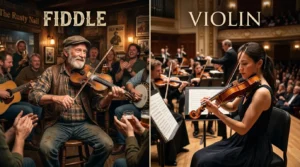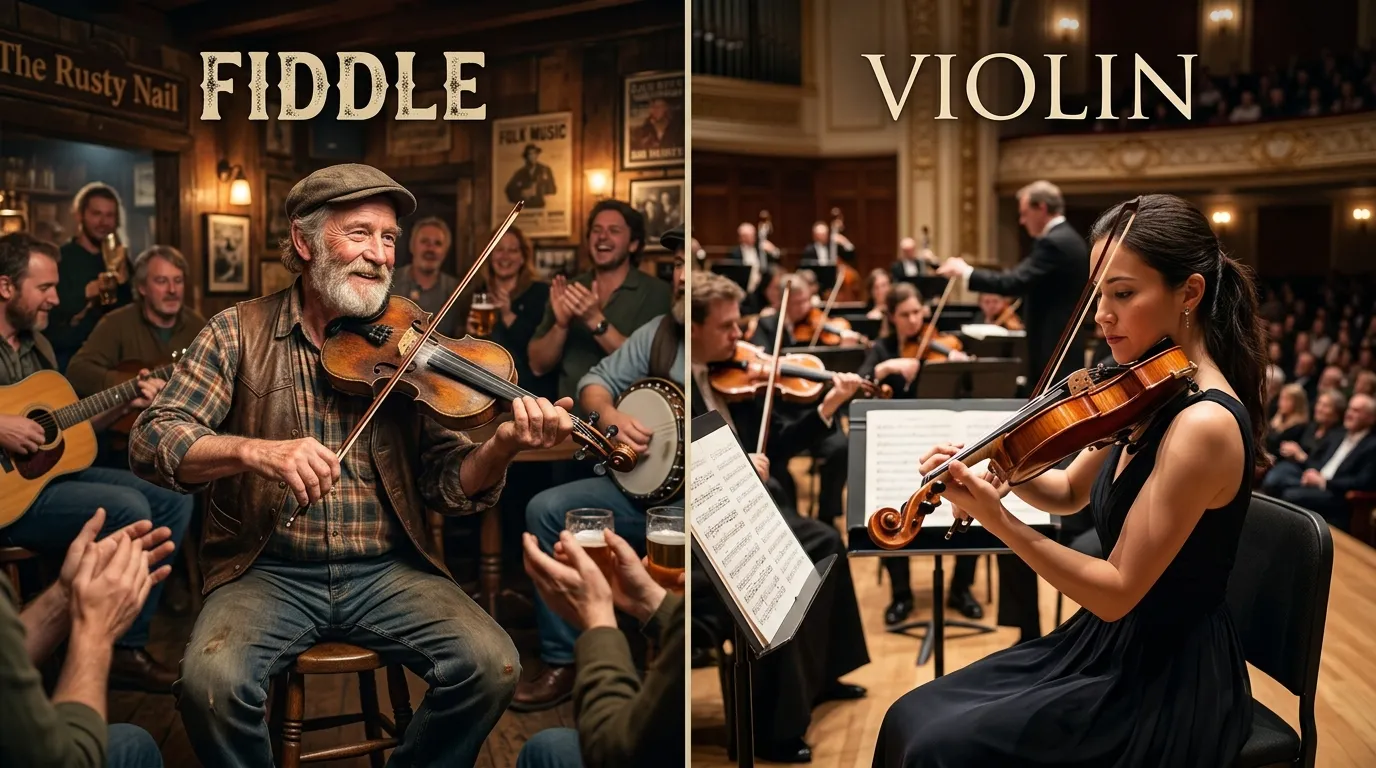
Imagine walking into a small village hall. A musician is playing a four-string instrument, and people are dancing around the room. Someone calls it a fiddle. The next day, you visit a concert hall and see another musician playing what looks like the same instrument. This time, everyone calls it a violin.
So, what is the difference between fiddle and violin?
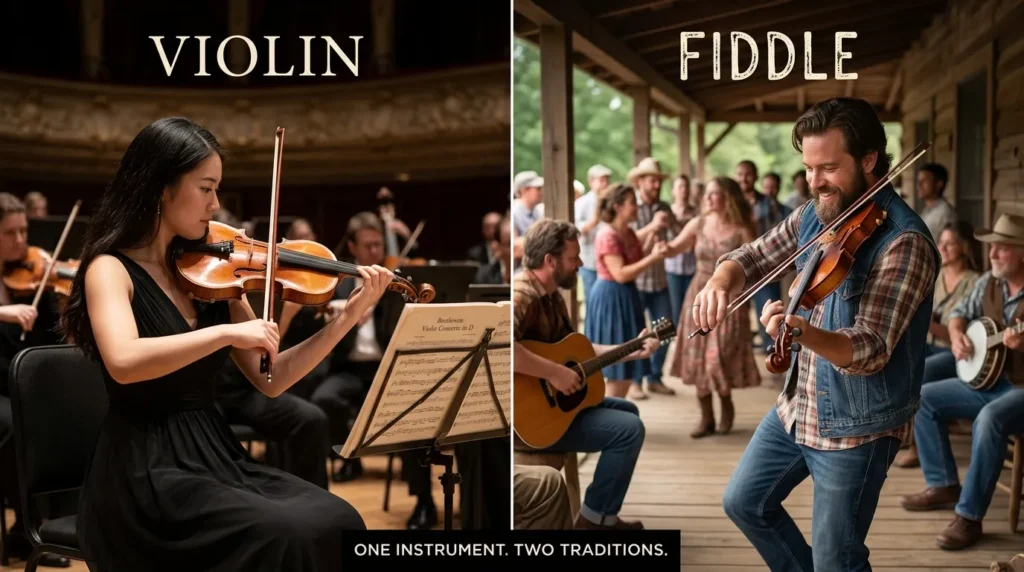
The simple answer may surprise you. In most cases, a fiddle and a violin are the same basic instrument. The name often changes because of the type of music, playing style, and setting. A violin is usually linked with classical music, orchestras, and formal performances. A fiddle is often linked with folk, country, bluegrass, Celtic, and dance music.
Understanding the difference between fiddle and violin can help music learners choose the right words. It also helps experts explain music traditions more clearly. Once you understand the difference between fiddle and violin, the two words become much easier to use.
Key Difference Between Fiddle and Violin
The biggest difference is how the instrument is used and played.
A violin is commonly used in classical music. Players often focus on clean notes, controlled bowing, tone, and musical detail.
A fiddle is commonly used in folk, country, bluegrass, Cajun, Irish, and Scottish music. Players often focus on rhythm, energy, quick movements, slides, and double stops.
However, there is no strict rule. A classical violinist may call their instrument a fiddle, and a fiddler can play an instrument that looks exactly like a classical violin.
Why Is the Difference Important for Learners and Experts?
Knowing the difference between these words helps learners speak about music correctly. A beginner who says “violin” usually talks about the instrument itself or classical playing. A person who says “fiddle” may be talking about folk or traditional playing.
For teachers, the difference is useful when explaining musical techniques. For musicians, it can show the tradition and style they follow.
The words also have social and cultural value. Fiddle music is closely connected with community dances, festivals, local traditions, and oral music traditions. Violin music has played an important role in orchestras, chamber music, concerts, schools, and music education.
So, learning these terms is not only about vocabulary. It is also about understanding how music connects people and cultures.
Pronunciation of Fiddle and Violin
Fiddle
US: /ˈfɪdəl/
UK: /ˈfɪdəl/
The stress is on the first syllable.
Violin
US: /ˌvaɪəˈlɪn/
UK: /ˌvaɪəˈlɪn/
The stress is on the last syllable.
Now that we know what both words mean and how to say them, let’s look at their differences one point at a time.
Difference Between Fiddle and Violin
1. Basic Meaning
Fiddle is a common, informal word for a violin, especially when it is used for folk or traditional music.
Violin is the standard name for the four-stringed bowed instrument.
Example 1:
She played the fiddle at the country dance.
Example 2:
He learned the violin at music school.
In most modern uses, the two words can describe the same physical instrument.
2. Music Style
The biggest practical difference is the style of music.
A violin is strongly connected with classical music. A fiddle is strongly connected with folk, country, bluegrass, Celtic, and other traditional styles.
Example 1:
The violinist performed a Mozart concerto.
Example 2:
The fiddler played a fast bluegrass tune.
3. Playing Technique
Fiddle playing often uses fast bow movements, slides, accents, and double stops. These techniques can make the music lively and suitable for dancing.
Violin playing often focuses on controlled bowing, smooth phrases, vibrato, intonation, and detailed musical expression.
Example 1:
The fiddler used two strings at the same time.
Example 2:
The violinist used smooth bowing during the concert.
Fiddle playing commonly gives more attention to rhythm and dance energy.
4. Instrument Setup
There is usually no major physical difference between a fiddle and a violin. However, some players change the setup to suit their style.
A fiddler may use a flatter bridge or steel strings. These choices can make fast string changes and double stops easier.
A classical violinist may prefer a more traditional setup designed for a broad range of tone and expression.
Example 1:
The fiddler chose a flatter bridge for easier double stops.
Example 2:
The violinist preferred a setup designed for classical performance.
5. Sound
Both instruments can produce a wide range of sounds.
The difference is usually not because one instrument is automatically a fiddle and the other is automatically a violin. The player’s technique and setup affect the sound.
Fiddle music often has a strong rhythmic and energetic sound.
Violin music may have a smooth, rich, controlled, or powerful sound.
Example 1:
The fiddle sounded bright and energetic during the dance.
Example 2:
The violin produced a warm tone during the orchestra performance.
6. Performance Setting
A violin is common in formal settings such as orchestras, concert halls, chamber groups, and music schools.
A fiddle is common at folk gatherings, country shows, bluegrass sessions, festivals, dances, and informal music events.
Example 1:
The violinist performed in a large concert hall.
Example 2:
The fiddler joined a group at a local folk festival.
7. Music Reading and Learning
Classical violin training often places strong attention on written music, scales, exercises, and formal technique.
Fiddle players may learn many tunes by listening and repeating them. Some fiddle traditions rely heavily on memory and oral teaching.
Example 1:
The violin student practiced a piece from sheet music.
Example 2:
The fiddler learned the tune by listening to an older player.
8. Rhythm
Rhythm is very important in many fiddle traditions.
Fiddle music often supports dancing, so the beat can feel strong and direct.
Violin music can also have strong rhythm, but classical violin playing often gives more attention to melody, tone, phrasing, and musical interpretation.
Example 1:
Everyone tapped their feet to the fiddle rhythm.
Example 2:
The violinist carefully shaped the melody of the concerto.
9. Cultural Connection
The word fiddle often carries a strong connection with local and traditional music.
It can remind people of Irish, Scottish, Appalachian, bluegrass, country, and other folk traditions.
The word violin is more universal in formal music education and classical music.
Example 1:
The fiddle was an important part of the village dance.
Example 2:
The violin became a key instrument in the school orchestra.
10. The Player’s Identity
The musician’s preferred word can also matter.
A person who mainly plays folk or bluegrass music may proudly call themselves a fiddler.
A musician who mainly performs classical music may call themselves a violinist.
But these titles are not strict rules.
Example 1:
She calls herself a fiddler because she plays traditional dance music.
Example 2:
He calls himself a violinist because he performs classical concerts.
Nature and Behavior of a Fiddle
A fiddle has a lively and social character in many musical traditions.
It often appears in music made for dancing, celebrations, festivals, family gatherings, and community events. Its playing style can be energetic and rhythmic.
Fiddle players may use quick bow movements, slides, accents, and double stops. They may also change melodies while playing instead of following every note from written music.
The fiddle is therefore strongly connected with movement, rhythm, tradition, and community.
Nature and Behavior of a Violin
The violin has a broad role in music.
It can be used in orchestras, string quartets, solo performances, chamber music, jazz, popular music, film music, and education.
Classical violin playing often demands careful control. Players work on intonation, bow control, vibrato, dynamics, phrasing, and musical expression.
The violin can produce soft, bright, deep, emotional, dramatic, and powerful sounds.
Why Are People Confused About Their Use?
People are confused because fiddle and violin can refer to the same physical instrument.
If you put a classical violin and a folk fiddle next to each other, you may not be able to tell which is which simply by looking.
The main difference comes from the musical context.
A person can play classical music in the morning and folk music in the evening using the same instrument. The instrument does not magically change when the musician changes styles.
Some players do change the setup, such as the bridge, strings, or tuners, but these are practical choices rather than a universal rule.
Fiddle vs. Violin: Difference and Similarity Table
| Feature | Fiddle | Violin |
|---|---|---|
| Basic instrument | Usually a violin | Four-string bowed instrument |
| Main use | Folk and traditional music | Classical and formal music |
| Common genres | Folk, country, bluegrass, Celtic, Cajun | Classical, orchestral, chamber, jazz |
| Physical body | Usually the same | Usually the same |
| Strings | Often steel in some traditions | Often synthetic or gut-core choices |
| Bridge | May be flatter | Often more traditionally arched |
| Playing style | Rhythmic and energetic | Controlled and expressive |
| Double stops | Very common in many fiddle styles | Also used, but differently |
| Vibrato | Often used less in many fiddle styles | Common in classical playing |
| Learning | Often learned by ear | Often uses sheet music |
| Main goal | Rhythm, dance, tradition, melody | Tone, intonation, expression |
| Player’s name | Fiddler | Violinist |
| Formality | Often informal/traditional | Often formal/classical |
| Same instrument? | Usually yes | Usually yes |
Which Is Better in What Situation?
Fiddle for Folk and Dance Music
A fiddle is better suited to situations where you want strong rhythm and traditional energy. It works very well in country, bluegrass, Irish, Scottish, Cajun, and other folk settings. A fiddle can support dancing and group singing. Its quick bowing, slides, and double stops can make the music lively.
Violin for Classical Music
A violin is the better term when talking about classical concerts, orchestras, string quartets, solo recitals, and formal music training. Classical violin playing requires careful control of tone, pitch, bowing, vibrato, and musical expression.
Both for Modern Music
Both can work well in jazz, pop, rock, film music, and other modern styles. In these settings, the words can sometimes be used interchangeably.
Fiddle and Violin in Metaphors and Similes
Writers can use these words to create pictures in the reader’s mind.
Fiddle Metaphors
- “His fiddle was the heartbeat of the village.”
This means his music brought energy to the community. - “Her words were a lively fiddle.”
This suggests her words were energetic and joyful.
Fiddle Similes
- “The music was as lively as a fiddle at a country dance.”
- “His fingers moved like a fiddle player racing through a fast tune.”
Violin Metaphors
- “Her voice was a silver violin.”
This compares her voice to the beautiful sound of a violin. - “His heart became a violin under pressure.”
This suggests his emotions became intense and sensitive.
Violin Similes
- “Her voice was as smooth as a violin.”
- “The melody rose like a violin singing above the orchestra.”
Connotative Meaning of Fiddle and Violin
Fiddle: Positive, Negative, and Neutral Meanings
The word fiddle is often neutral or positive when talking about music.
Positive: It can suggest fun, tradition, dancing, warmth, and community.
Neutral: It can simply mean a violin used in a particular musical context.
Negative: In other contexts, “fiddle” can mean to waste time or handle something carelessly.
Example:
“Stop fiddling with your phone and finish your work.”
Here, fiddling does not mean playing a musical instrument.
Violin: Positive, Negative, and Neutral Meanings
The word violin usually has a neutral or positive meaning.
It can suggest beauty, skill, art, emotion, discipline, and classical music.
Positive example:
“Her violin performance was beautiful and emotional.”
Neutral example:
“The violin is a common instrument in a symphony orchestra.”
The word normally does not have the same negative everyday meaning that “fiddle” can have.
Idioms and Proverbs Related to Fiddle and Violin
There are several common expressions using fiddle. There are fewer fixed English idioms using the word violin.
1. Fit as a Fiddle
Meaning: Very healthy or in good condition.
Example:
“After a short rest, Grandpa was fit as a fiddle.”
2. Play Second Fiddle
Meaning: To have a less important role than another person.
Example:
“She does not like to play second fiddle to anyone.”
3. Fiddling While Rome Burns
Meaning: Wasting time while a serious problem needs attention.
Example:
“The company is losing money, but the manager is fiddling while Rome burns.”
4. Fiddle-Faddle
Meaning: Silly talk, activity, or unnecessary details.
Example:
“Enough of this fiddle-faddle; let’s finish the project.”
5. Violin Expression
There is no equally common traditional English idiom based directly on violin. However, writers often use the violin symbolically to represent sadness, beauty, sensitivity, or emotional expression.
Example:
“His voice sounded like a lonely violin in the night.”
Works in Literature Featuring Fiddle or Violin
- “The Fiddler of Dooney” — W. B. Yeats, 1892
Genre: Poetry. The poem presents a fiddler whose music is connected with dancing, joy, and identity. - “The Fiddler” — Herman Melville, 1854
Genre: Short story. The story uses the figure of a fiddler while exploring artistic ambition and fame. - “Fiddler Jones” — Edgar Lee Masters, 1915
Genre: Poetry / dramatic monologue. The poem presents a character whose love of music shapes his life and memories. - “The Corn-Stalk Fiddle” — Paul Laurence Dunbar, 1913
Genre: Poetry. The poem celebrates homemade music, dancing, community, and rural life. - The Violinist’s Thumb — Sam Kean, 2012
Genre: Popular science / nonfiction. The book uses the violinist’s hand as part of a wider discussion of genetics, history, and human ability.
Movies Featuring Fiddle or Violin
- Fiddler on the Roof — 1971 — United States
Genre: Musical drama. The movie is based on the stage musical and features the famous image of a fiddler on a roof. - The Red Violin — 1998 — Canada / Italy / United Kingdom
Genre: Drama. The story follows a famous red violin through different countries and periods of history. - The Fiddler — 2011 — Cyprus
Genre: Short drama. The story follows a poor man who dreams of owning a violin and becoming a fiddler.
Frequently Asked Questions
1. Is a fiddle the same as a violin?
Usually, yes. A fiddle and a violin are normally the same basic four-string instrument. The main difference is how the instrument is played and the type of music being performed.
2. Is a fiddle easier to play than a violin?
Not necessarily. Fiddle music may use simpler-looking techniques, but fast fiddle tunes can be very difficult. Classical violin also requires advanced technical skills.
3. Can a violin become a fiddle?
Yes. A violin can be used for fiddle music. Some players change the setup, but the instrument itself does not need to become a completely different instrument.
4. Do fiddles and violins sound different?
They can sound different because of playing technique, strings, bridge setup, bowing, and musical style. But there is no single sound that makes an instrument officially a fiddle or violin.
5. Should I learn fiddle or violin?
Choose violin if you are interested in classical music, orchestras, recitals, and formal training. Choose fiddle if you are more interested in folk, country, bluegrass, Celtic, or traditional dance music. You can also learn both styles.
How Are Both Useful for Their Surroundings?
A fiddle can bring people together at dances, festivals, local celebrations, cultural events, and community gatherings. It helps preserve traditional songs and musical styles. In many communities, fiddle music is passed from one generation to another.
The violin also has a major social role. It is used in schools, orchestras, concerts, churches, cultural programs, film music, and public performances. Learning violin can help students build patience, focus, listening skills, and teamwork.
Both instruments can create social connections. They can turn a quiet gathering into a musical event and help people share culture through sound.
Final Words for Fiddle and Violin
The most important thing to remember is simple: a fiddle and a violin are usually the same basic instrument.
The word violin is more common in classical and formal music. The word fiddle is more common in folk, country, bluegrass, Celtic, and traditional music.
There can be small setup differences, but these are not absolute rules. A musician can use the same instrument as both a violin and a fiddle.
So, instead of asking which instrument is “real,” it is better to understand the musical tradition, playing technique, and situation.
Conclusion
The difference between fiddle and violin is mainly about language, musical style, technique, and context rather than the basic instrument itself. Both normally have four strings and are played with a bow. A violin is often connected with classical music, orchestras, concerts, and formal training. A fiddle is often connected with folk, country, bluegrass, Celtic, and dance music. Some fiddlers change their instrument setup to make certain techniques easier, but there is no strict physical line between the two.
Understanding these words makes music discussions easier. It also helps learners appreciate the rich traditions behind both names. Whether it is called a fiddle or a violin, the instrument continues to bring beauty, emotion, rhythm, and people together.