Many people feel confused. They ask, “Are they the same?” or “Which one should I learn?”
This confusion is normal. Both SRE and DevOps aim to improve how software is built and run. They both focus on speed, quality, and teamwork. That is why people often mix them up.
But there is a clear difference between SRE and DevOps. They use different methods to reach similar goals.
In this guide, you will learn everything in very simple words. You will understand what SRE and DevOps mean, how they are different, and which one may be better for your needs.
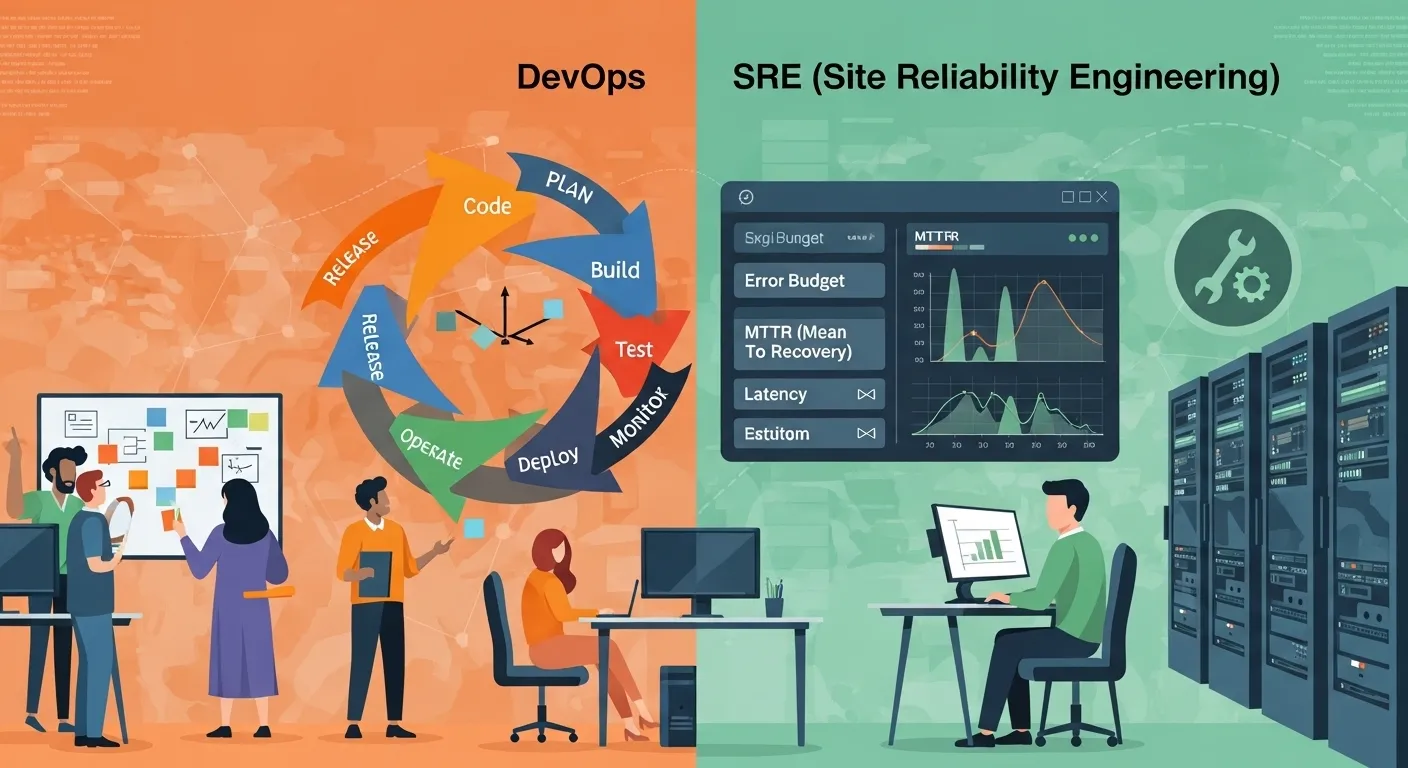
The main difference between SRE and DevOps is the approach. DevOps is a culture and set of practices that improve teamwork between development and operations. SRE is a specific role and method that uses software engineering to manage system reliability and performance.
What Is SRE?
SRE stands for Site Reliability Engineering.
It is a job role and a way of working. SRE uses software engineering to keep systems stable and reliable.
SRE teams focus on uptime, performance, and fixing problems quickly. They often write code to automate tasks.
SRE started at Google. It helps manage large systems smoothly.
Simple Example
A website goes down. The SRE team finds the issue and fixes it fast. \
Basic Features of SRE
- Focus on system reliability
- Uses code and automation
- Monitors system health
- Handles incidents and outages
- Works with metrics like uptime
What Is DevOps?
DevOps is a way of working.
It is not just one role. It is a culture that connects developers and operations teams.
DevOps helps teams build, test, and release software faster. It focuses on teamwork and continuous delivery.
Simple Example
A team builds a new app feature. With DevOps, they test and release it quickly without delays.
Basic Features of DevOps
- Focus on collaboration
- Faster software delivery
- Uses automation tools
- Continuous integration and delivery (CI/CD)
- Improves workflow
Difference Between SRE and DevOps
Here is a simple comparison table:
| Feature | SRE | DevOps |
| Type | Role and practice | Deployment speed, success rate |
| Main Focus | Reliability and uptime | Speed and collaboration |
| Goal | Keep systems stable | Deliver software faster |
| Work Style | Engineering-based | Team-based workflow |
| Tools | Monitoring and automation tools | CI/CD and automation tools |
| Origin | From Google | From industry practices |
| Responsibilities | Manage system performance | Improve development process |
| Metrics | Uptime, error rates | Deployment speed, success rate |
Key Differences Explained
Purpose
SRE focuses on system reliability.
DevOps focuses on improving the development process.
Example:
SRE ensures your app stays online. DevOps ensures your app is released faster.
Work Style
SRE is a specific engineering role.
DevOps is a shared team culture.
Example:
SRE engineers write code for system stability. DevOps involves all team members working together.
Focus Area
SRE works on uptime and performance.
DevOps works on speed and efficiency.
Example:
If a system crashes, SRE fixes it. DevOps ensures updates are smooth and fast.
Tools and Practices
SRE uses monitoring tools and automation.
DevOps uses CI/CD pipelines and collaboration tools.
Example:
SRE tracks system errors. DevOps manages code deployment.
Measurement
SRE measures success using uptime and error rates.
DevOps measures success using delivery speed and team performance.
Examples
Here are simple real-life examples.
Example 1: Website Crash
An online store stops working.
SRE fixes the issue and prevents future failures.
DevOps improves the system so updates do not cause crashes.
Example 2: New Feature Release
A company launches a new feature.
DevOps helps release it quickly.
SRE ensures the system stays stable after release.
Example 3: Automation
DevOps builds pipelines for fast delivery.
SRE builds tools to monitor and fix system issues.
Importance of Knowing the Difference
Understanding the difference helps in many ways.
It helps you choose the right career path.
It helps companies build better teams.
It reduces confusion in job roles.
Knowing both helps you grow in tech.
Benefits of Understanding SRE vs DevOps
- Helps you pick the right career
- Improves teamwork knowledge
- Reduces confusion in roles
- Helps in job interviews
- Builds better technical skills
- Supports smarter decisions
- Improves system understanding
Common Mistakes People Make
Many people misunderstand these terms.
Mistake 1: Thinking SRE and DevOps are the same
They are related but not the same.
Mistake 2: Treating DevOps as a job title
DevOps is a culture, not just one role.
Mistake 3: Ignoring reliability
Speed is important, but stability matters too.
Mistake 4: Using tools without culture
DevOps is not just about tools. It is teamwork.
Real-Life Use
SRE and DevOps are used in tech companies.
Who Uses SRE?
- Large companies with complex systems
- Teams needing high uptime
Who Uses DevOps?
- Software development teams
- Startups and enterprises
When to Use Which?
- Use DevOps to improve workflow
- Use SRE to maintain system stability
Most modern companies use both together.
Easy Trick to Remember the Difference
Here is a simple trick:
SRE = Stability and Reliability
DevOps = Development + Operations
This helps you remember quickly.
Which One Is Better?
There is no single winner.
Both SRE and DevOps are important.
- Choose DevOps if you like teamwork and fast delivery
- Choose SRE if you like system stability and problem-solving
Most companies need both.
They work together for better results.
FAQs
1. What is the main difference between SRE and DevOps?
SRE focuses on system reliability, while DevOps focuses on improving development and delivery processes.
2. Is SRE part of DevOps?
SRE can be seen as a way to implement DevOps goals using engineering practices.
3. Which is better, SRE or DevOps?
Both are important. The better choice depends on your role and goals.
4. Can a person do both SRE and DevOps?
Yes, many professionals work in both areas.
5. Is DevOps a job role?
Not exactly. It is more of a culture and approach.
6. What skills are needed for SRE?
Programming, system monitoring, and problem-solving skills.
7. Why do people confuse SRE and DevOps?
Both focus on improving software systems and often work together.
Conclusion
Understanding the difference between SRE and DevOps helps you see how modern tech teams work.
DevOps focuses on teamwork, speed, and smooth software delivery. SRE focuses on system reliability, uptime, and stability.
DevOps helps build and release software faster. SRE ensures that software runs without problems.