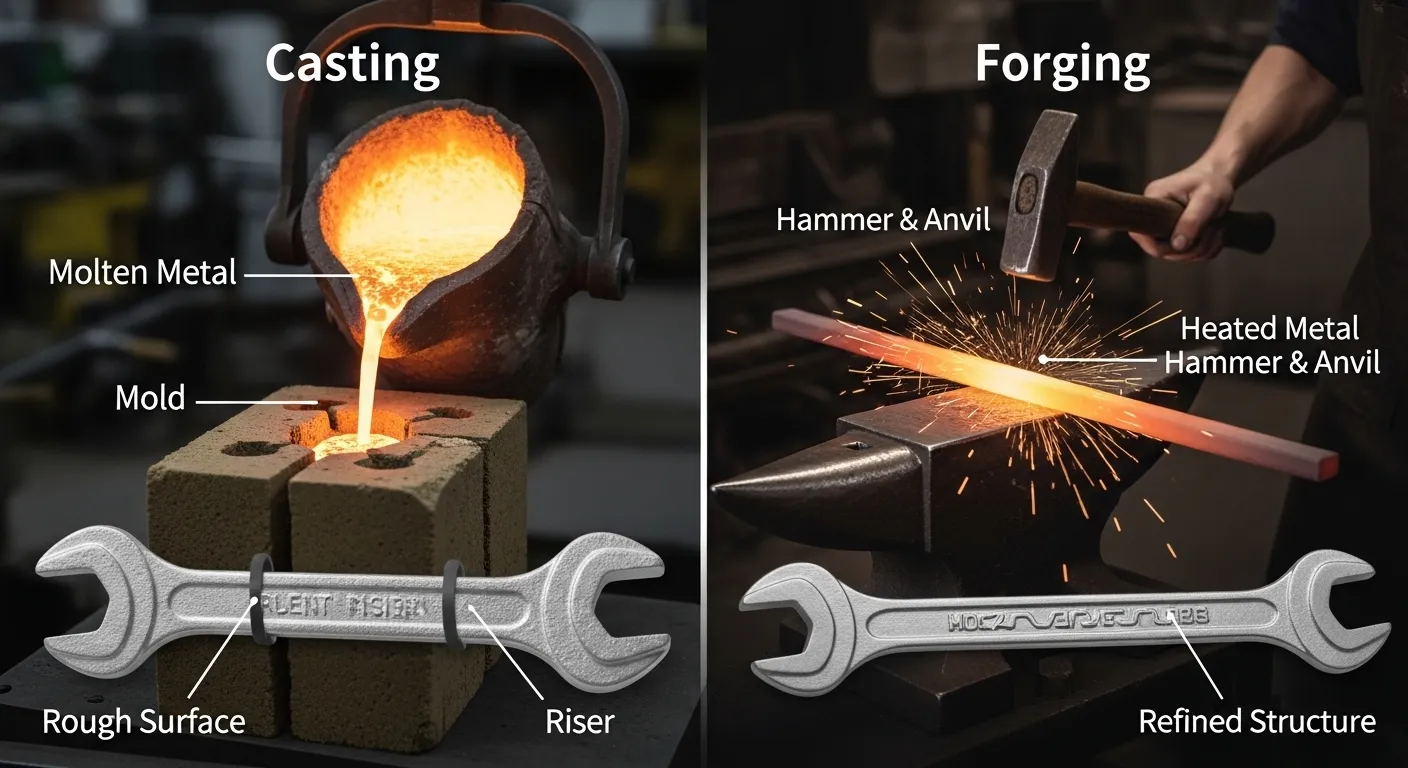
Imagine a blacksmith in a small village, heating a piece of iron until it glows bright orange. With every powerful strike of his hammer, he shapes the metal into a sturdy tool. Now picture a modern factory where molten metal is poured into molds to create complex machine parts with precision. These two scenes perfectly capture the difference between casting and forging two essential manufacturing processes used for shaping metals.
The difference between casting and forging lies not just in how metal is shaped, but also in the strength, structure, and purpose of the final product. While casting involves pouring liquid metal into molds, forging shapes solid metal using force and pressure. Understanding the difference between casting and forging helps engineers, manufacturers, and even students grasp how everyday objects, from car parts to kitchen tools, are made.
In today’s industrial world, knowing the difference between casting and forging is crucial because each method serves a unique purpose. Whether it’s durability, cost-efficiency, or design complexity, choosing the right process can significantly impact product performance.
🔑 Key Difference Between Casting and Forging
The main difference is simple:
- Casting involves pouring molten (liquid) metal into a mold.
- Forging involves shaping solid metal using heat and mechanical force.
🌍 Why Is It Important to Know the Difference?
Understanding the difference between casting and forging is vital for both learners and professionals. Engineers need it to select the right manufacturing method, while students benefit by building strong technical foundations. In society, these processes influence the quality of infrastructure, vehicles, tools, and even medical equipment. A wrong choice could mean weaker products or higher costs. Therefore, this knowledge ensures safety, efficiency, and innovation in modern industries.
🔊 Pronunciation
- Casting
- US: /ˈkæs.tɪŋ/
- UK: /ˈkɑː.stɪŋ/
- Forging
- US: /ˈfɔːr.dʒɪŋ/
- UK: /ˈfɔː.dʒɪŋ/
Now that you understand the basics, let’s dive deeper into the difference between casting and forging in detail.
🆚 Difference Between Casting and Forging
1. Process Method
- Casting uses molten metal poured into molds.
- Example: Engine blocks
- Example: Decorative statues
- Forging uses heat and pressure to shape solid metal.
- Example: Hammered swords
- Example: Crankshafts
2. Material State
- Casting: Metal is in liquid form.
- Example: Aluminum casting
- Example: Iron casting
- Forging: Metal remains solid (heated but not melted).
- Example: Steel rods
- Example: Forged bolts
3. Strength
- Casting: Generally less strong due to internal defects.
- Example: Cast pipes
- Example: Cast fittings
- Forging: Stronger due to grain alignment.
- Example: Aircraft parts
- Example: High-strength tools
4. Grain Structure
- Casting: Random grain structure.
- Example: Cast gears
- Example: Valve bodies
- Forging: Refined and aligned grain structure.
- Example: Forged shafts
- Example: Axles
5. Complexity of Shape
- Casting: Suitable for complex shapes.
- Example: Turbine blades
- Example: Sculptures
- Forging: Limited to simpler shapes.
- Example: Bars
- Example: Rings
6. Surface Finish
- Casting: Smoother finish directly from the mold.
- Example: Jewelry casting
- Example: Art pieces
- Forging: Rough finish, needs machining.
- Example: Industrial parts
- Example: Tools
7. Cost
- Casting: Lower cost for complex designs.
- Example: Mass-produced parts
- Example: Automotive components
- Forging: Higher cost due to equipment and labor.
- Example: Aerospace components
- Example: Heavy-duty tools
8. Defects
- Casting: More prone to defects like air bubbles.
- Example: Porosity in pipes
- Example: Cracks in molds
- Forging: Fewer defects.
- Example: Strong bolts
- Example: Reliable gears
9. Production Volume
- Casting: Ideal for large-scale production.
- Example: Engine parts
- Example: Machine housings
- Forging: Suitable for high-strength, limited production.
- Example: Custom tools
- Example: Specialized parts
10. Applications
- Casting: Used in decorative and complex items.
- Example: Statues
- Example: Pump housings
- Forging: Used in high-strength applications.
- Example: Automotive parts
- Example: Military equipment
🔍 Nature and Behaviour
- Casting: Flexible, adaptable, and ideal for intricate designs. However, it may lack strength.
- Forging: Strong, durable, and reliable under stress, but less flexible in design.
🤔 Why Are People Confused?
People often confuse casting and forging because both involve heating metal and shaping it. The final products may also look similar. However, the internal structure and strength differ significantly, which is not visible to the naked eye.
📊 Comparison Table
| Feature | Casting | Forging |
| Method | Liquid metal poured into mold | Solid metal shaped by force |
| Strength | Moderate | Very high |
| Shape Complexity | High | Limited |
| Cost | Lower for complex designs | Higher |
| Defects | More common | Less common |
| Surface Finish | Smooth | Rough |
| Grain Structure | Random | Aligned |
| Production | Mass production | Limited production |
| Applications | Decorative & complex parts | Strong mechanical parts |
| Similarity | Both shape metal using heat | Both used in manufacturing |
⚖️ Which Is Better in What Situation?
Casting is better when you need complex shapes, detailed designs, and cost-effective production. It is widely used in art, automotive parts, and machinery where intricate geometry is required.
Forging is better when strength and durability are critical. It is ideal for heavy-duty applications like aerospace, construction, and tools that must withstand high stress.
🧠 Metaphors and Similes
- Casting: “Like pouring ideas into a mold to shape creativity.”
- Forging: “Like forging a strong character through life’s challenges.”
🎭 Connotative Meaning
- Casting: Neutral (creation, formation)
- Example: “Casting new opportunities in life.”
- Forging: Positive (strength, resilience)
- Example: “Forging a strong future.”
🗣️ Idioms & Proverbs
- “Strike while the iron is hot” (related to forging)
- Example: Take action at the right time.
- “Cast the first stone.”
- Example: Don’t judge others quickly.
📚 Works in Literature
- The Forge – Seamus Heaney (Poetry, 1969)
- The Casting of the Rings – J.R.R. Tolkien (Fantasy, 1955)
🎬 Movies Related to the Themes
- The Lord of the Rings (2001, New Zealand/USA)
- Forged in Fire (2015, USA – TV Series)
❓ FAQs
1. What is the main difference between casting and forging?
Casting uses liquid metal, while forging shapes solid metal using force.
2. Which is stronger, casting or forging?
Forging is stronger due to better grain structure.
3. Is casting cheaper than forging?
Yes, especially for complex shapes.
4. Where is forging commonly used?
In aerospace, automotive, and heavy machinery.
5. Can casting replace forging?
Not always, especially when strength is critical.
🌱 Usefulness in Surroundings
Both casting and forging are essential in everyday life. From the pipes in your home to the engine in your car, these processes ensure functionality, safety, and durability in modern living.
✨ Final Words
Casting and forging are not competitors they are partners in manufacturing. Each has its own strengths and ideal applications.
🧾 Conclusion
The difference between casting and forging goes far beyond simple manufacturing techniques. It reflects a balance between creativity and strength, flexibility and durability. Casting allows us to create complex, detailed shapes with ease, while forging gives us the power to build strong and reliable components that can withstand extreme conditions.
Understanding the difference between casting and forging empowers individuals to make better decisions in engineering, manufacturing, and even daily life. Whether you are a student, professional, or curious learner, knowing when to use each method can lead to improved efficiency, cost savings, and product performance.
.