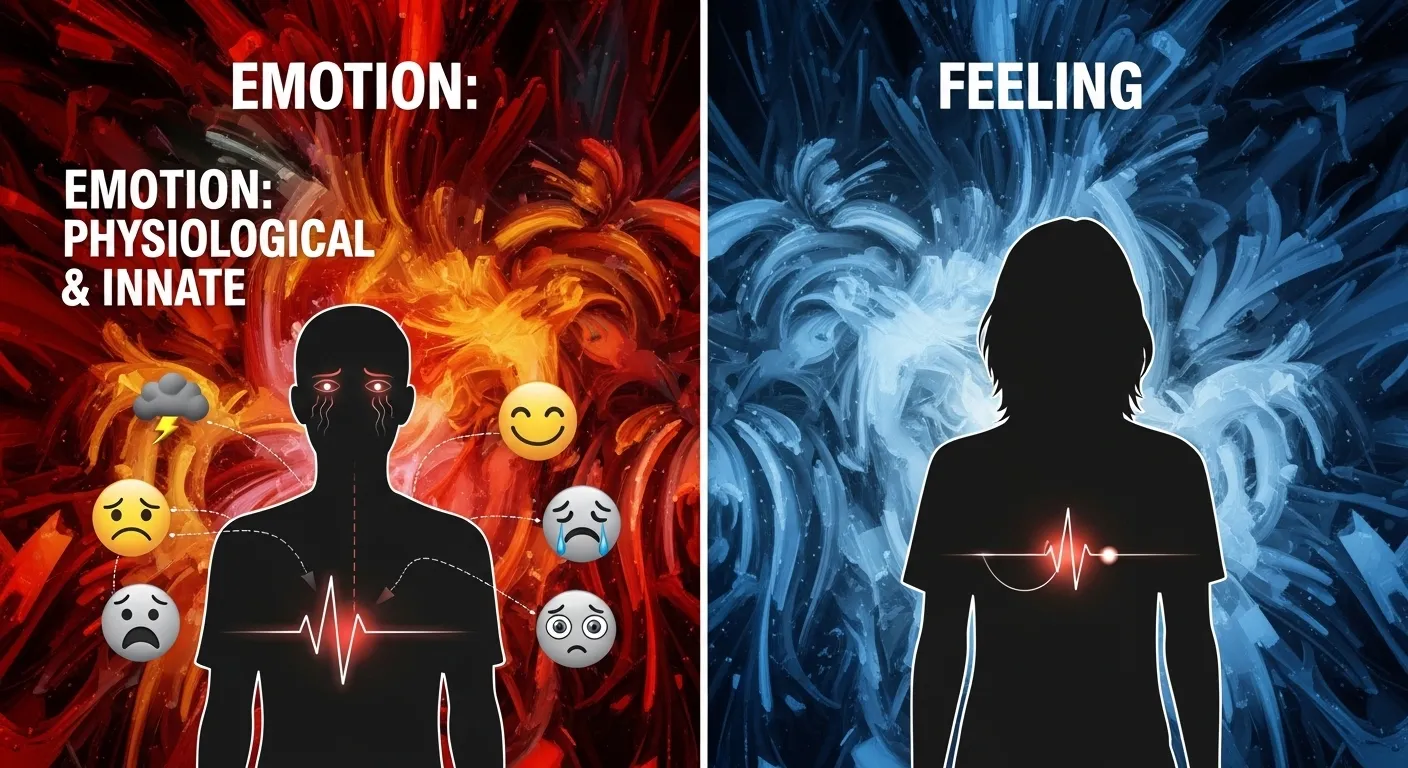
Imagine you’re walking alone at night and suddenly hear footsteps behind you. Instantly, your heart starts racing; that’s an emotion. A few seconds later, you think, “I feel scared,” that’s a feeling. This simple moment beautifully explains the difference between emotion and feeling.
In everyday life, people often use these terms interchangeably, but the difference between emotion and feeling is bigger than it seems. Emotions are automatic, biological responses triggered by the brain, while feelings are the conscious interpretation of those emotions. Understanding the difference between emotion and feeling helps us better manage our reactions, relationships, and mental well-being.
The difference between emotion and feeling is especially important in psychology, communication, and self-awareness. When you know what you’re experiencing internally, you can respond more thoughtfully instead of reacting impulsively.
🔑 Key Difference Between Emotion and Feeling
- Emotion: An automatic physical response to a stimulus
- Feeling: A conscious experience or interpretation of that emotion
🌍 Why Is It Important to Know This Difference?
Understanding the difference between emotion and feeling helps individuals improve emotional intelligence. In society, it plays a crucial role in relationships, mental health, and communication. For learners and professionals, this knowledge leads to better decision-making and empathy. Recognizing emotions versus feelings allows people to control their responses and build healthier interactions.
🔊 Pronunciation
- Emotion
- US: /ɪˈmoʊ.ʃən/
- UK: /ɪˈməʊ.ʃən/
- Feeling
- US: /ˈfiː.lɪŋ/
- UK: /ˈfiː.lɪŋ/
Now, let’s explore the difference between emotion and feeling in detail.
🆚 Difference Between Emotion and Feeling
1. Definition
- Emotion: Biological reaction
- Example: Fear when hearing a loud noise
- Example: Joy when seeing a loved one
- Feeling: Mental interpretation
- Example: Saying “I feel afraid”
- Example: Feeling happy all day
2. Nature
- Emotion: Automatic and instinctive
- Example: Sudden anger
- Example: Immediate surprise
- Feeling: Conscious and reflective
- Example: Thinking about why you’re angry
- Example: Reflecting on happiness
3. Duration
- Emotion: Short-lived
- Example: Quick burst of fear
- Example: Sudden excitement
- Feeling: Longer-lasting
- Example: Ongoing sadness
- Example: Lasting contentment
4. Origin
- Emotion: Comes from the brain (limbic system)
- Example: Fight-or-flight response
- Example: Instinctive reactions
- Feeling: Comes from cognitive processing
- Example: Interpreting a situation
- Example: Personal thoughts
5. Awareness
- Emotion: Often unconscious
- Example: Body reacts before thinking
- Example: Reflex actions
- Feeling: Fully conscious
- Example: Recognizing your mood
- Example: Expressing feelings
6. Expression
- Emotion: Shown physically
- Example: Sweating, heart rate
- Example: Facial expressions
- Feeling: Expressed verbally
- Example: Saying “I feel sad”
- Example: Sharing emotions
7. Control
- Emotion: Hard to control
- Example: Sudden anger
- Example: Fear response
- Feeling: Easier to manage
- Example: Calming yourself
- Example: Reframing thoughts
8. Complexity
- Emotion: Basic and universal
- Example: Happiness
- Example: Anger
- Feeling: Complex and personal
- Example: Bittersweet emotions
- Example: Mixed feelings
9. Examples in Daily Life
- Emotion: Startle reaction
- Example: Jumping at loud sound
- Example: Laughing suddenly
- Feeling: Emotional state
- Example: Feeling relaxed
- Example: Feeling anxious
10. Role
- Emotion: Triggers response
- Example: Run from danger
- Example: Smile at joy
- Feeling: Guides behavior
- Example: Avoid situations
- Example: Seek comfort
🔍 Nature and Behaviour
- Emotion: Fast, automatic, and physical.
- Feeling: Slow, conscious, and mental.
🤔 Why Are People Confused?
People confuse emotions and feelings because they happen almost at the same time. The transition from emotion to feeling is so quick that it feels like a single experience.
📊 Comparison Table
| Feature | Emotion | Feeling |
| Definition | Biological response | Mental interpretation |
| Nature | Automatic | Conscious |
| Duration | Short | Long |
| Control | Difficult | Manageable |
| Expression | Physical | Verbal |
| Similarity | Both relate to experiences | Both affect behavior |
⚖️ Which Is Better in What Situation?
Emotions are essential for survival. They help you react quickly to danger or opportunity. Without emotions, humans would struggle to respond to immediate situations.
Feelings are better for decision-making and relationships. They allow you to reflect, communicate, and understand yourself and others more deeply.
🧠 Metaphors and Similes
- Emotion: “Like a lightning strike, fast and powerful.”
- Feeling: “Like a slow-burning flame steady and lasting.”
🎭 Connotative Meaning
- Emotion: Neutral (natural reaction)
- Example: “Emotions guide instincts.”
- Feeling: Positive (awareness and reflection)
- Example: “Feelings help us understand ourselves.”
🗣️ Idioms & Proverbs
- “Wear your heart on your sleeve.”
- Example: Showing feelings openly
- “Gut feeling”
- Example: Instinct influenced by emotion
📚 Works in Literature
- Emotional Intelligence – Daniel Goleman (Psychology, 1995)
- Feeling Good – David D. Burns (Self-help, 1980)
🎬 Movies
- Inside Out (2015, USA)
- The Pursuit of Happyness (2006, USA)
❓ FAQs
1. Are emotions and feelings the same?
No, emotions are automatic, while feelings are conscious.
2. Which comes first, emotion or feeling?
Emotion comes first.
3. Can you control emotions?
Not easily, but you can control feelings.
4. Why are feelings important?
They help in understanding and communication.
5. Do animals have emotions or feelings?
They have emotions; feelings are debated.
🌱 Usefulness in Daily Life
Understanding emotions and feelings improves communication, relationships, and mental health. It helps people respond thoughtfully rather than react impulsively.
✨ Final Words
Emotions are the spark, and feelings are the story you tell about that spark.
🧾 Conclusion
The difference between emotion and feeling lies in awareness, control, and duration. Emotions are immediate, automatic responses, while feelings are the conscious interpretation of those responses. Together, they shape human experience.
By understanding the difference between emotion and feeling, you can improve emotional intelligence, build stronger relationships, and make better decisions. In the end, both are essential; one helps you react, the other helps you understand.