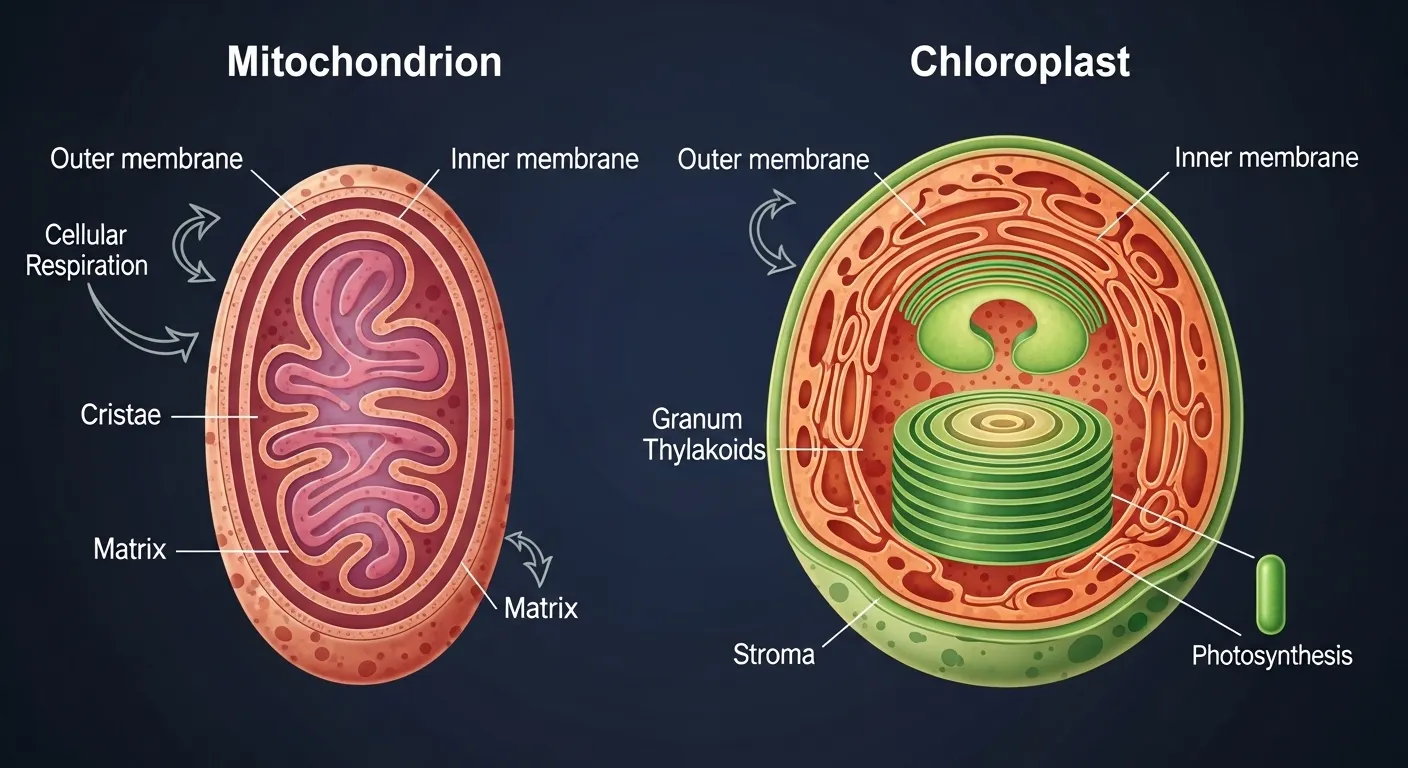
Imagine a green plant growing in sunlight. Inside its tiny cells, many important activities are happening. Some parts of the cell produce energy, while others help the plant make its own food. Two important structures responsible for these tasks are mitochondria and chloroplasts. Understanding the difference between mitochondria and chloroplasts helps us see how living cells survive and function.
Mitochondria are often called the “powerhouses of the cell” because they produce energy needed for cellular activities. Chloroplasts, on the other hand, help plants make food through photosynthesis. Although both are important cell organelles, there is a clear difference between mitochondria and chloroplasts in their roles and structures. Students of biology frequently study the difference between mitochondria and chloroplasts to understand how plants and cells work. Learning the difference between mitochondria and chloroplasts helps us understand the processes that support life on Earth.
Key Difference Between the Two
The main difference between mitochondria and chloroplast is that mitochondria produce energy from food through cellular respiration, while chloroplasts produce food using sunlight through photosynthesis.
Why Is Their Difference Necessary to Know for Learners and Experts?
Understanding the difference between mitochondria and chloroplasts is essential in biology and life sciences. These organelles play major roles in how cells obtain and use energy.
For learners, this knowledge helps them understand plant biology, cell functions, and basic life processes. For scientists and experts, studying these organelles helps improve research in genetics, agriculture, medicine, and environmental science. In society, understanding these processes helps people learn how plants produce oxygen and food for life on Earth. Therefore, knowing the difference between mitochondria and chloroplasts is important for education, scientific research, and environmental awareness.
Pronunciation of the Keywords
Mitochondria
- US: /ˌmaɪ.t̬oʊˈkɑːn.dri.ə/
- UK: /ˌmaɪ.təʊˈkɒn.dri.ə/
Chloroplast
- US: /ˈklɔːr.ə.plæst/
- UK: /ˈklɔː.rə.plɑːst/
Linking Hook
Now that we understand the basic meaning and importance of these cell structures, let us explore the difference between mitochondria and chloroplast in detail with clear explanations and examples.
Difference Between Mitochondria and Chloroplast
1. Main Function
Mitochondria produce energy for the cell through cellular respiration.
Chloroplasts produce food for plants through photosynthesis.
Examples for mitochondria:
- Animal cells use mitochondria to produce energy.
- Muscle cells contain many mitochondria because they need energy.
Examples for chloroplasts:
- Plant leaves contain chloroplasts for photosynthesis.
- Algae use chloroplasts to make food from sunlight.
2. Presence in Cells
Mitochondria are found in both plant and animal cells.
Chloroplasts are found mainly in plant cells and algae.
Examples for mitochondria:
- Human cells contain mitochondria.
- Plant cells also contain mitochondria.
Examples for chloroplasts:
- Green plant cells have chloroplasts.
- Algae contain chloroplasts for photosynthesis.
3. Energy Process
Mitochondria perform cellular respiration.
Chloroplasts perform photosynthesis.
Examples for mitochondria:
- Glucose is broken down to release energy.
- Cells produce ATP through respiration.
Examples for chloroplasts:
- Sunlight is used to produce glucose.
- Photosynthesis releases oxygen.
4. Color and Pigment
Mitochondria are colorless organelles.
Chloroplasts are green because of chlorophyll.
Examples for mitochondria:
- Mitochondria cannot be seen easily without special staining.
- They do not contain pigments.
Examples for chloroplasts:
- Chloroplasts appear green in plant cells.
- Chlorophyll absorbs sunlight.
5. Internal Structure
Mitochondria contain folded inner membranes called cristae.
Chloroplasts contain thylakoids and grana structures.
Examples for mitochondria:
- Cristae increase surface area for energy production.
- The mitochondrial matrix contains enzymes.
Examples for chloroplasts:
- Grana stacks help in photosynthesis.
- Thylakoids capture sunlight energy.
6. Role in Food Production
Mitochondria do not produce food.
Chloroplasts produce glucose for plants.
Examples for mitochondria:
- They break down nutrients.
- They convert food energy into ATP.
Examples for chloroplasts:
- Plants create sugar using sunlight.
- Leaves store energy from photosynthesis.
7. Source of Energy
Mitochondria obtain energy from chemical nutrients.
Chloroplasts obtain energy from sunlight.
Examples for mitochondria:
- Cells use glucose to generate energy.
- Oxygen helps release energy during respiration.
Examples for chloroplasts:
- Sunlight powers photosynthesis.
- Light energy is converted into chemical energy.
8. Oxygen Involvement
Mitochondria use oxygen during respiration.
Chloroplasts release oxygen during photosynthesis.
Examples for mitochondria:
- Oxygen helps break down glucose.
- Cells need oxygen for energy production.
Examples for chloroplasts:
- Oxygen is released as a by-product.
- Plants provide oxygen to the atmosphere.
9. Importance for Life
Mitochondria support energy production in all living cells.
Chloroplasts support food production in plants.
Examples for mitochondria:
- Humans depend on mitochondrial energy.
- Animals rely on cellular respiration.
Examples for chloroplasts:
- Plants produce food for ecosystems.
- Photosynthesis supports the food chain.
10. Overall Role in the Cell
Mitochondria act as energy producers.
Chloroplasts act as food producers.
Examples for mitochondria:
- Cells depend on ATP from mitochondria.
- High-energy cells contain many mitochondria.
Examples for chloroplasts:
- Plants produce glucose through chloroplasts.
- Chloroplasts support plant growth.
Nature and Behaviour of Both
Mitochondria are energy-producing organelles that break down nutrients to generate ATP, the main energy source for cells.
Chloroplasts are food-producing organelles that capture sunlight and convert it into chemical energy through photosynthesis.
Why People Are Confused About Their Use?
Students often confuse mitochondria and chloroplasts because both are cell organelles involved in energy-related processes. They also share some structural similarities, such as having double membranes and their own DNA. However, their functions and locations within living organisms are very different.
Table Showing Differences and Similarities
| Aspect | Mitochondria | Chloroplast | Similarity |
| Function | Energy production | Food production | Both produce energy-related molecules |
| Cells | Plant and animal cells | Plant cells only | Both are organelles |
| Process | Cellular respiration | Photosynthesis | Both involve chemical reactions |
| Color | Colorless | Green | Both have double membranes |
| Energy Source | Chemical nutrients | Sunlight | Both support cell survival |
Which Is Better in What Situation?
Mitochondria are essential in situations where cells require energy for movement, growth, and metabolism. Animal cells rely heavily on mitochondria to produce ATP, which powers body functions such as muscle contraction, brain activity, and digestion. Without mitochondria, cells would not be able to perform essential life processes.
Chloroplasts are essential for plants and photosynthetic organisms. They allow plants to produce food using sunlight, carbon dioxide, and water. This process not only feeds plants but also supports the entire food chain and releases oxygen into the atmosphere, which is necessary for most living organisms.
How the Keywords Are Used in Metaphors and Similes
Mitochondria metaphor
Example:
“The power station of the cell is like mitochondria.”
Simile example:
“The factory worked like mitochondria producing energy.”
Chloroplast metaphor
Example:
“Chloroplasts are the solar panels of plant cells.”
Simile example:
“The leaves worked like chloroplasts capturing sunlight.”
Connotative Meaning
Mitochondria
Positive: power, energy, strength
Example: “Mitochondria represent the energy center of life.”
Neutral: biological organelle
Example: “Scientists study mitochondria in cells.”
Chloroplast
Positive: growth, nature, sustainability
Example: “Chloroplasts symbolize green life and energy.”
Neutral: plant cell structure
Example: “Chloroplasts help plants produce food.”
Idioms or Proverbs Related to the Words
There are no common idioms directly related to these biological terms, but similar expressions exist.
“The engine of something” (similar to mitochondria)
Example: “Innovation is the engine of economic growth.”
“Green energy” (similar to chloroplast activity)
Example: “Plants represent the idea of green energy in nature.”
Works in Literature Mentioning the Keywords
- The Biology of the Cell — Science/Biology, Bruce Alberts, 1983
- Molecular Biology of the Cell — Academic Biology Text, Bruce Alberts and others, 1983
Movies Related to the Theme
- Fantastic Voyage — 1966, USA (explores the human body and cells)
- Osmosis Jones — 2001, USA (animated story about human body functions)
Frequently Asked Questions
1. What is the main difference between mitochondria and chloroplast?
Mitochondria produce energy through respiration, while chloroplasts produce food through photosynthesis.
2. Are mitochondria found in plant cells?
Yes, mitochondria are found in both plant and animal cells.
3. Do animal cells have chloroplasts?
No, chloroplasts are only found in plants and some algae.
4. Why are chloroplasts green?
Because they contain chlorophyll pigment.
5. Why are mitochondria called the powerhouse of the cell?
Because they produce ATP, the main energy source for cellular activities.
How Both Are Useful for Surroundings
Mitochondria and chloroplasts both support life on Earth. Mitochondria help organisms use energy from food, while chloroplasts help plants produce food and oxygen. Together, they maintain the balance of energy and oxygen in ecosystems.
Final Words for Both
Mitochondria and chloroplasts are essential cell organelles that perform different but equally important roles in sustaining life.
Conclusion
The difference between mitochondria and chloroplast lies mainly in their functions and locations within living cells. Mitochondria are responsible for producing energy through cellular respiration and are found in both plant and animal cells. Chloroplasts, on the other hand, perform photosynthesis and are mainly found in plant cells and algae. Although both organelles are involved in energy-related processes, their roles are different and complementary. Understanding the difference between mitochondria and chloroplast helps students and scientists learn how cells function and how life on Earth depends on energy production and food creation.