Have you ever measured a garden or a sports field and wondered whether to use yards or meters? Imagine running a race on a track, knowing the difference between yards and meters can change your strategy!
A yard is a unit of length commonly used in the United States, while a meter is part of the metric system and is used globally. Understanding the difference between yards and meters helps students, athletes, surveyors, content writers, and everyday English users measure distances accurately.
Pronunciation:
- Yard – US/UK: /jɑrd/
- Meter – US: /ˈmiː.tɚ/ | UK: /ˈmiː.tə/
Let’s explore the main differences between yards and meters, their uses, and why it’s important to know both.
H2: Key Differences Between Yards and Meters
1. Unit System
Meaning: Yards are used in the imperial/US customary system; meters are metric.
Examples:
- A football field is 100 yards long.
- A 100-meter sprint is a standard Olympic race.
2. Length Value
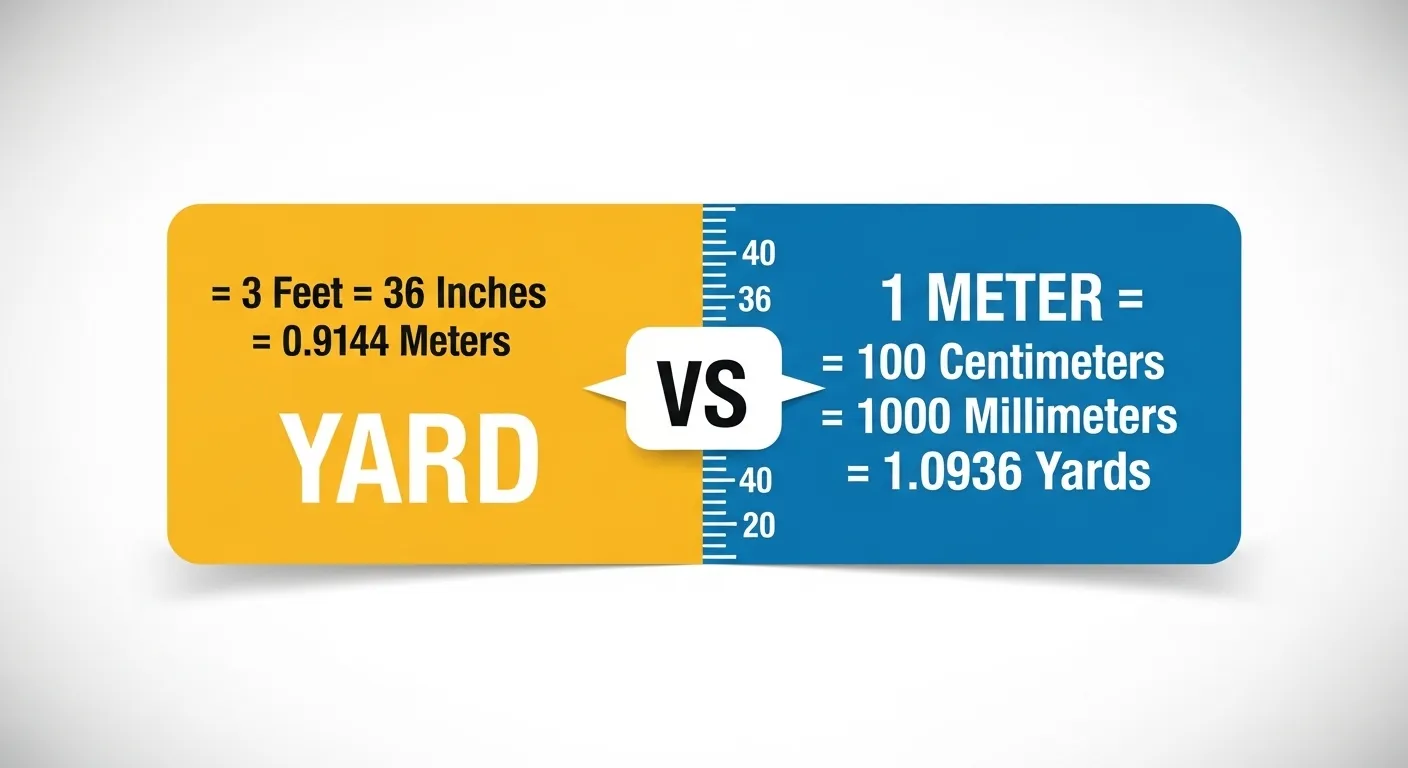
Meaning: 1 yard = 0.9144 meters. 1 meter = 1.0936 yards.
Examples:
- 10 yards equal 9.144 meters.
- 10 meters equals 10.936 yards.
3. Usage in Countries
Meaning: Yards are mostly used in the US, UK, and some Commonwealth countries; meters are global.
Examples:
- US football fields are measured in yards.
- Track events worldwide use meters.
4. Application in Sports
Meaning: Yards are common in American sports; meters in international competitions.
Examples:
- The NFL measures first downs in yards.
- Olympic runners compete in 100 meters.
5. Conversion
Meaning: Yards can be converted to meters using multiplication by 0.9144; meters to yards by 1.0936.
Examples:
- 50 yards × 0.9144 = 45.72 meters.
- 60 meters × 1.0936 = 65.62 yards.
6. Everyday Use
Meaning: Yards are used for land and sports; meters are used for science, construction, and daily measurements.
Examples:
- The backyard is 20 yards long.
- The swimming pool is 25 meters long.
7. Measuring Tools
Meaning: Yardsticks and tape measures in yards; metric rulers and measuring tapes in meters.
Examples:
- He used a yardstick for the garden fence.
- She measured the room with a meter tape.
8. Precision
Meaning: Meters are used in scientific work for precision; yards are less precise for small measurements.
Examples:
- Engineers use meters for building plans.
- Gardeners use yards for approximate distances.
9. Symbol
Meaning: Yard is abbreviated as yd; meter as m.
Examples:
- The field is 120 yd long.
- The road is 500 m long.
10. Historical Origin
Meaning: Yard has old English roots; meter comes from the French metric system.
Examples:
- The yard was defined in England centuries ago.
- The meter was introduced during the French Revolution.
Nature and Behaviour of Yards and Meters
- Yard: Imperial, longer than a meter, mostly used in the US and UK, good for casual and sports measurements.
- Meter: Metric, internationally standard, precise, widely used in science, construction, and travel.
Why People Are Confused
Confusion arises because both measure length, and many people are not familiar with the conversion factor (1 yard ≈ 0.9144 meters). International sports and travel often mix the two units.
Table: Difference and Similarity
| Feature | Yard | Meter | Similarity |
| System | Imperial/US customary | Metric | Both measure length |
| Length | 0.9144 meters | 1 meter = 1.0936 yards | Both are standard units |
| Countries Used | US, UK, some Commonwealth | Global | Both recognized internationally |
| Sports | NFL, golf | Olympics, swimming | Both used in sports |
| Conversion | 1 yd = 0.9144 m | 1 m = 1.0936 yd | Both can be converted |
| Symbol | yd | m | Both have abbreviations |
| Precision | Moderate | High | Both measure distance |
| Everyday Use | Land, casual measurement | Science, construction | Both practical for measuring |
| Historical Origin | Old English | French metric system | Both standardized |
| Tools | Yardstick, tape | Meter tape, ruler | Both require measuring tools |
Which Is Better in What Situation?
- Yards: Ideal for sports like football or golf, informal land measurement, and situations familiar to US/UK users.
- Meters: Better for scientific work, construction, international sports, travel, and precise measurements.
Metaphors and Similes
- Yard: “The garden stretched a hundred yards, like a long, calm river.”
- Meter: “He ran 100 meters as fast as a lightning strike.”
Connotative Meaning
- Yard: Neutral; casual, familiar.
- Example: “The backyard is 15 yards wide.”
- Meter: Positive; precise, scientific, modern.
- Example: “The bridge is 500 meters long.”
Idioms / Proverbs
- “Give an inch, take a mile” – relates to measuring distances.
- Example: A meter or a yard, always measure correctly!
- “Every little bit counts” – small distance matters.
Works in Literature
- “The Long Yard” – Sports fiction, William Goldman, 1974
- “Metric Matters” – Educational science, Emily Carter, 2010
Movies Related to Yards/Meters
- “The Long Yard” – 1974, USA, Sports
- “100 Meters” – 2016, Spain, Drama/Sports
Frequently Asked Questions
- How many meters are in a yard?
- 1 yard = 0.9144 meters.
- How many yards are in a meter?
- 1 meter ≈ 1.0936 yards.
- Which is more widely used?
- Meters are used globally; yards are mostly in US/UK.
- Can I mix yards and meters in measurements?
- Yes, but convert one to the other for consistency.
- Which is better for sports tracks?
- Meters, for international competitions; yards, for American football fields.
How Both Are Useful for the Surroundings
- Yards: Measure gardens, sports fields, and casual distances in US/UK.
- Meters: Measure roads, buildings, international tracks, and scientific distances efficiently.
Final Words
Knowing the difference between yards and meters ensures accuracy in sports, construction, and daily life. Both have their place depending on region, purpose, and precision needed.
Conclusion
Yards and meters are fundamental units of length. Yards are familiar and used in sports and casual measurements in the US and UK. Meters, as the international standard, are precise and ideal for science, construction, and global measurements. Understanding the difference between yards and meters helps students, athletes, engineers, and travelers avoid mistakes and ensures accurate measurement.