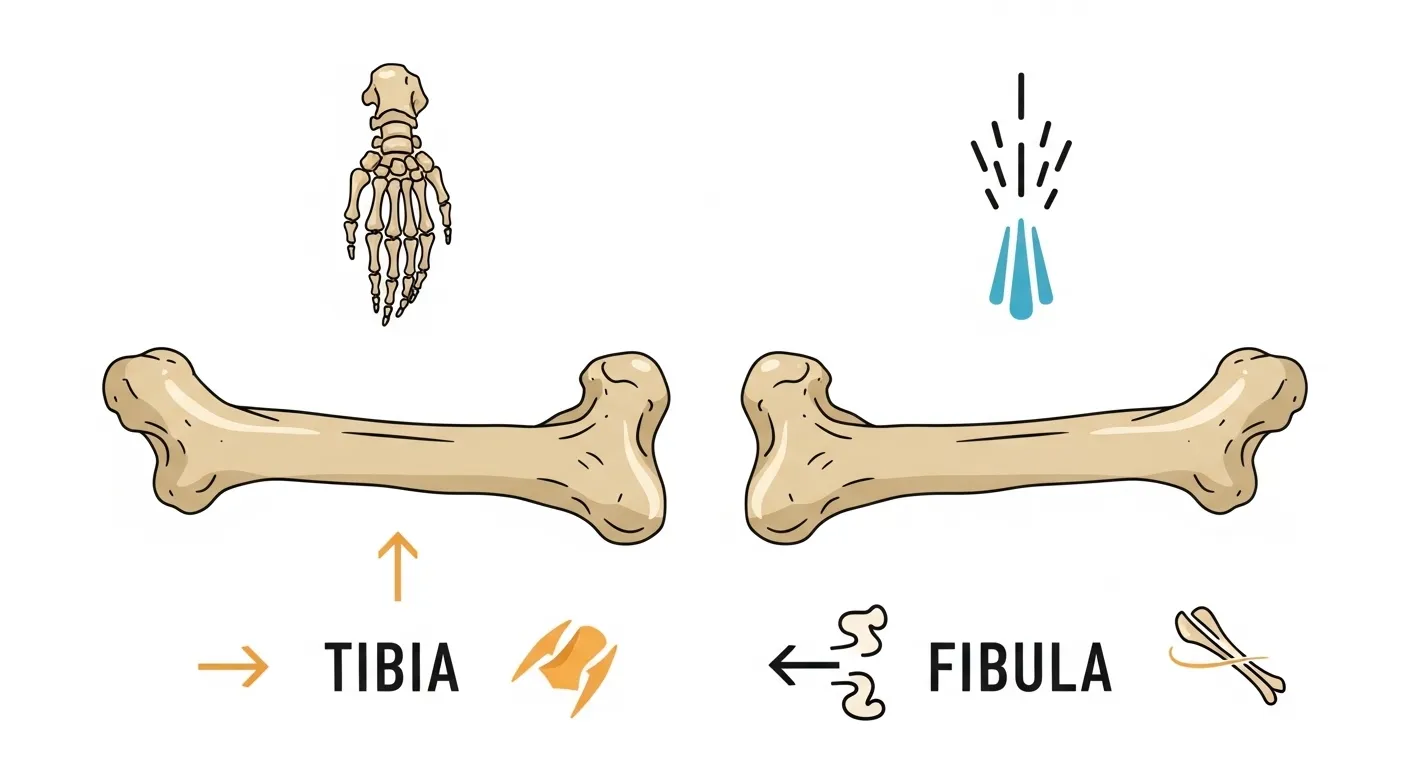
Imagine a person playing football who suddenly falls and injures their lower leg. At the hospital, the doctor says the injury involves either the tibia or the fibula. Many people are surprised because they thought the lower leg had only one bone. In reality, two bones work together to support the leg: the tibia and the fibula. Understanding the difference between tibia and fibula helps students, athletes, and medical learners understand how the human body works.
The difference between tibia and fibula mainly lies in their size, strength, and function. The tibia is the larger, weight-bearing bone of the lower leg, while the fibula is thinner and mainly supports muscle attachment and ankle stability. Knowing the difference between tibia and fibula is important in anatomy, sports medicine, and injury treatment.
Key Difference Between the Both
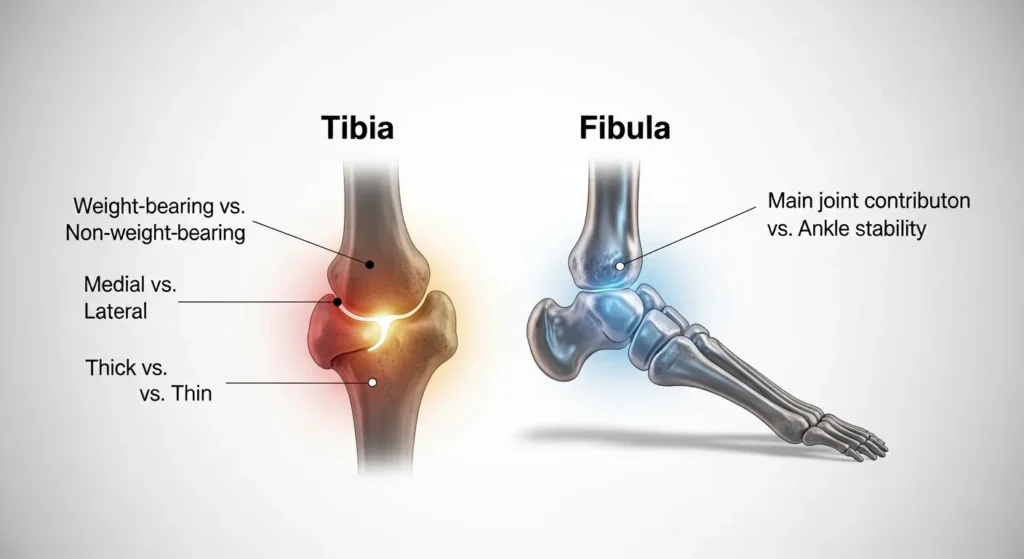
The tibia is the main weight-bearing bone in the lower leg, while the fibula is a slender bone that provides support and stability but carries very little body weight.
Why Their Difference Is Necessary to Know
Knowing the difference is essential for doctors, physiotherapists, athletes, and students. It helps diagnose fractures, understand leg movement, and design treatments. In sports and healthcare, recognizing the difference between tibia and fibula can prevent injuries and improve recovery strategies. Society benefits because better anatomical knowledge leads to better medical care.
Pronunciation (US & UK)
Tibia
- US: /ˈtɪb.i.ə/
- UK: /ˈtɪb.i.ə/
Fibula
- US: /ˈfɪb.jə.lə/
- UK: /ˈfɪb.jʊ.lə/
Before moving deeper, let’s clearly explore the detailed difference between tibia and fibula.
Difference Between Tibia and Fibula
1. Size and Thickness
The tibia is thick and strong, while the fibula is long but thin.
Tibia Examples
- The shinbone visible at the front of the leg.
- A tibia fracture from a sports injury.
Fibula Examples
- A slender bone running beside the tibia.
- A fibula crack during ankle twist.
2. Weight-Bearing Function
The tibia supports most of the body’s weight.
The fibula supports very little weight.
Tibia Examples
- Standing upright relies on the tibia.
- Walking and running put pressure on the tibia.
Fibula Examples
- Helps stabilize the ankle joint.
- Supports muscles around the lower leg.
3. Location in the Leg
The tibia is located on the inner side of the lower leg.
The fibula is located on the outer side.
Tibia Examples
- The bone that forms the shin.
- Easily felt under the skin at the front of the leg.
Fibula Examples
- The bone near the outer ankle.
- Runs parallel to the tibia.
4. Strength
The tibia is one of the strongest bones in the body.
The fibula is comparatively weaker.
Tibia Examples
- Supports body weight during jumping.
- Bears pressure during lifting heavy objects.
Fibula Examples
- Helps with balance.
- Supports muscle attachment.
5. Role in Joints
The tibia forms part of both the knee and ankle joints.
The fibula mainly forms part of the ankle joint.
Tibia Examples
- Connects with the femur at the knee.
- Connects with the talus at the ankle.
Fibula Examples
- Forms the outer ankle bone (lateral malleolus).
- Supports ankle stability.
6. Shape
The tibia has a triangular shaft and wide ends.
The fibula is narrow and cylindrical.
Tibia Examples
- Broad upper surface supporting knee joint.
- Wide lower end forming ankle joint.
Fibula Examples
- Slender shaft along the outer leg.
- Narrow upper end connecting near the knee.
7. Fracture Frequency
Tibia fractures are more common because they bear weight.
Fibula fractures usually occur with ankle injuries.
Tibia Examples
- Car accident leg fracture.
- Sports shin injury.
Fibula Examples
- Ankle twist fracture.
- Stress fracture in runners.
8. Muscle Attachment
The tibia provides attachment for several large muscles.
The fibula mainly serves as an attachment for smaller muscles.
Tibia Examples
- Attachment for thigh and leg muscles.
- Important for movement during walking.
Fibula Examples
- Muscle attachment for ankle motion.
- Helps control foot rotation.
9. Medical Importance
Tibia injuries often require surgery or casts.
Fibula injuries sometimes heal with minimal treatment.
Tibia Examples
- Surgery with metal rods.
- Long recovery period.
Fibula Examples
- Mild fractures treated with support.
- Shorter healing time.
10. Visibility and Palpation
The tibia is easily visible under the skin.
The fibula is less visible and located deeper.
Tibia Examples
- The shin bump felt easily.
- The bone hit during a shin injury.
Fibula Examples
- Outer ankle bone felt on the side.
- Less noticeable along the leg.
Nature and Behaviour
Tibia: Strong, central, and primary support bone of the lower leg.
Fibula: Slim, supportive bone that assists with balance and muscle movement.
Why People Are Confused About Their Use
People often think the lower leg contains only one bone because the tibia is more visible. The fibula is thinner and less noticeable, so many people assume it has the same role as the tibia.
Table: Difference and Similarity Between Tibia and Fibula
| Feature | Tibia | Fibula | Similarity |
| Size | Thick and strong | Thin and slender | Both are lower-leg bones |
| Function | Weight bearing | Support and stability | Work together for movement |
| Position | Inner side of leg | Outer side of leg | Parallel bones |
| Strength | Very strong | Relatively weaker | Part of skeletal system |
| Joint Role | Knee and ankle | Mostly ankle | Help leg mobility |
Which Is Better in What Situation?
Tibia (100 words)
The tibia is crucial for supporting body weight and maintaining posture. During walking, running, jumping, and standing, the tibia acts as the main support structure. Without the tibia, the body would not be able to carry weight efficiently. It also forms important connections with the knee and ankle joints, allowing smooth movement. In medical treatments, protecting the tibia is important because fractures can affect mobility and require long recovery periods.
Fibula (100 words)
The fibula plays a supportive role that complements the tibia. Although it does not carry much body weight, it helps stabilize the ankle and provides attachment points for muscles. This stability is important for balance, especially during sports activities like running or turning quickly. The fibula also helps control foot movement and contributes to ankle strength. Even though it is thinner than the tibia, it is still essential for proper leg function.
Use in Metaphors and Similes
- “Strong as a tibia supporting the body.”
- “Slim like the fibula beside the shin.”
These comparisons highlight strength versus support.
Connotative Meaning
Tibia
- Positive: Strength and support
- Neutral: Anatomical bone term
Fibula
- Positive: Balance and stability
- Neutral: Supporting bone
Idioms or Proverbs
Direct idioms are rare, but expressions related to bones are used.
“Bone of contention”
Example: The injury became the bone of contention between the teams.
“Make no bones about it.”
Example: Doctors make no bones about the seriousness of tibia fractures.
Works in Literature
- “Gray’s Anatomy” – Medical reference book, Henry Gray, 1858
- “Anatomy and Physiology” – Educational textbook, Elaine Marieb, 1998
Movies Related to Medical Themes
- The Doctor – 1991, USA
- Gifted Hands: The Ben Carson Story – 2009, USA
Frequently Asked Questions
1. Which bone is stronger, the tibia or the fibula?
The tibia is much stronger and carries most body’s weight.
2. Can you walk with a broken fibula?
Sometimes yes, depending on severity, because it bears little weight.
3. Why is the tibia called the shinbone?
It forms the visible front part of the lower leg.
4. Are tibia and fibula connected?
Yes, they are connected by ligaments and a membrane.
5. Which bone forms the outer ankle?
The fibula forms the outer ankle bone.
How Both Are Useful for the Surroundings
Together, the tibia and fibula allow humans to walk, run, and maintain balance. Their cooperation supports daily activities and athletic performance.
Final Words
The tibia provides strength and weight support, while the fibula offers stability and muscle attachment. Both bones work together to create efficient leg movement.
Conclusion
Understanding the difference between tibia and fibula helps people appreciate how the human body functions. The tibia acts as the strong, weight-bearing bone of the lower leg, while the fibula provides support and stability for muscles and the ankle joint. Although their roles differ, both bones are essential for movement, balance, and overall mobility. For students, medical professionals, and athletes, knowing these differences improves anatomical knowledge and helps in diagnosing and preventing injuries.