One evening during Ramadan, Ayesha noticed her younger brother quietly placing some money into a charity box at their local mosque. Curious, she asked, “Is that your Zakat?” He replied, “No, it’s just Sadaqah.”
That simple exchange sparked a deeper question: What exactly is the difference between Sadaqah and Zakat?
Like many Muslims, Ayesha had grown up hearing both terms frequently, especially during Ramadan. Yet, the distinction wasn’t always clear. Both involve giving to those in need, both are acts of worship, and both bring spiritual rewards. However, they are not the same.
Understanding the difference between Sadaqah and Zakat is essential for fulfilling religious obligations correctly and maximizing the impact of your charity.
Quick Answer
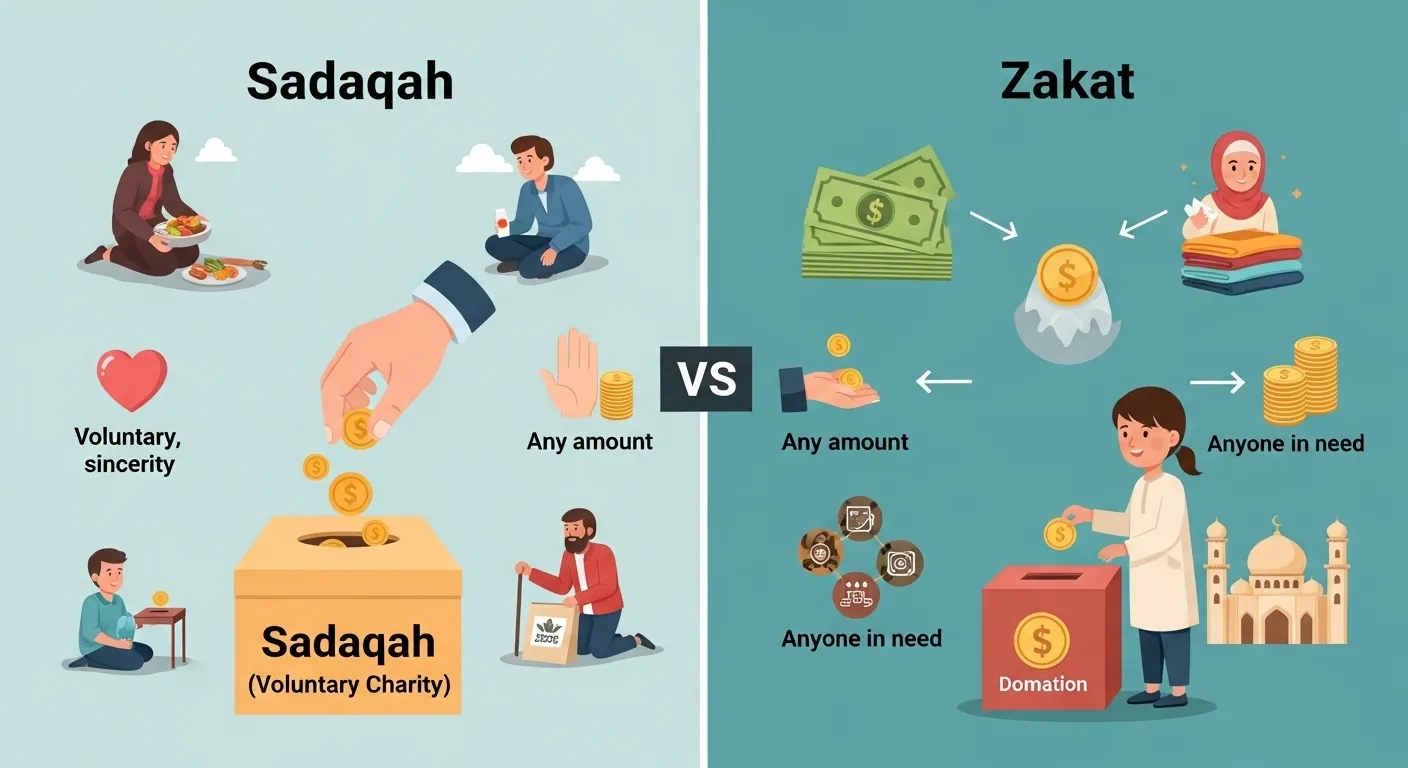
- Zakat is a mandatory charity in Islam, usually 2.5% of eligible wealth, given once a year.
- Sadaqah is a voluntary charity, which can be given anytime, in any amount.
In short, Zakat is an obligation, while Sadaqah is a choice.
What is Zakat?
Zakat is one of the Five Pillars of Islam, making it a fundamental act of worship for eligible Muslims.
Key Features of Zakat:
- Obligatory (Fard) for financially capable Muslims
- Typically 2.5% of savings/wealth
- Paid once every lunar year
- Distributed to specific categories of people (as defined in Islamic teachings)
- Purifies wealth and soul
Who Must Pay Zakat?
A Muslim must pay Zakat if they:
- Own wealth above a minimum threshold (Nisab)
- Have held that wealth for one lunar year
Real-World Example:
If someone has savings of PKR 500,000 for a year, they must pay 2.5% (PKR 12,500) as Zakat to eligible recipients.
What is Sadaqah?
Sadaqah is a voluntary act of charity that can be given at any time, in any amount.
Key Features of Sadaqah:
- Optional (Nafl)
- No fixed amount or percentage
- Can be given anytime
- Not limited to money (can include acts of kindness)
- Given to anyone in need
Types of Sadaqah:
- Monetary donations
- Helping someone in need
- Feeding the poor
- Even a smile is considered Sadaqah
Real-World Example:
Giving food to a hungry neighbor or donating clothes to the needy is considered Sadaqah.
Zakat vs Sadaqah: Key Differences
| Feature | Zakat | Sadaqah |
| Obligation | Mandatory (Fard) | Voluntary (Nafl) |
| Amount | Fixed (usually 2.5%) | No fixed amount |
| Timing | Once a year | Anytime |
| Eligibility | Only for specific recipients | Can be given to anyone |
| Purpose | Purification of wealth | General charity and kindness |
| Religious Status | One of the Five Pillars | Recommended good deed |
| Form | Usually monetary | Money, food, help, or actions |
Why Both Are Important
Both Zakat and Sadaqah play vital roles in Islam:
Zakat:
- Reduces poverty systematically
- Ensures wealth distribution
- Strengthens the community
Sadaqah:
- Encourages continuous kindness
- Builds compassion
- Helps in emergencies and daily needs
When to Use Zakat vs Sadaqah
Give Zakat When:
- You meet the Nisab threshold
- A full lunar year has passed
- You want to fulfill a religious obligation
Give Sadaqah When:
- You want to help someone immediately
- You don’t meet Zakat requirements
- You seek extra spiritual reward
- You want to give beyond Zakat
Pros and Spiritual Benefits
Benefits of Zakat:
- Fulfills a core Islamic duty
- Purifies wealth
- Brings blessings (barakah)
- Helps reduce inequality
Benefits of Sadaqah:
- Flexible and easy to give
- Can be done daily
- Protects from hardship (as believed in Islamic teachings)
- Increases generosity and empathy
Common Misconceptions
1. “Sadaqah can replace Zakat”
❌ Incorrect Zakat is mandatory and cannot be replaced by voluntary charity.
2. “Only money counts as Sadaqah”
❌ Incorrect, even small acts of kindness count.
3. “Zakat can be given to anyone.”
❌ Incorrect it must go to specific eligible groups.
Real-Life Scenario
Scenario 1:
During Ramadan, Ahmed calculates his savings and pays Zakat to गरीब families.
👉 This is Zakat (obligatory).
Scenario 2:
The next day, he buys food for a poor person on the street.
👉 This is Sadaqah (voluntary).
Internal Linking Suggestions
For an Islamic or educational blog, you can link this article to:
- “What is Zakat and How to Calculate It?”
- “Importance of Charity in Islam”
- “Difference Between Fard and Sunnah”
- “Benefits of Giving Charity in Ramadan”
FAQs
1. Can Sadaqah be given instead of Zakat?
No, Zakat is compulsory and must be given separately.
2. Is there a minimum amount for Sadaqah?
No, you can give any amount even a small act counts.
3. Who can receive Zakat?
Specific categories like the poor, needy, and others are defined in Islamic teachings.
4. Can non-Muslims receive Sadaqah?
Yes, Sadaqah can be given to anyone in need.
5. Is Sadaqah only given during Ramadan?
No, it can be given at any time throughout the year.
Conclusion
The difference between Sadaqah and Zakat lies in their obligation, purpose, and flexibility. Zakat is a mandatory pillar of Islam with specific rules, while Sadaqah is a voluntary act of kindness that knows no limits.
Both forms of charity are essential. Zakat ensures justice and balance in society, while Sadaqah spreads compassion and humanity.
Understanding this difference helps you fulfill your religious duties correctly and make a meaningful impact in the lives of others.