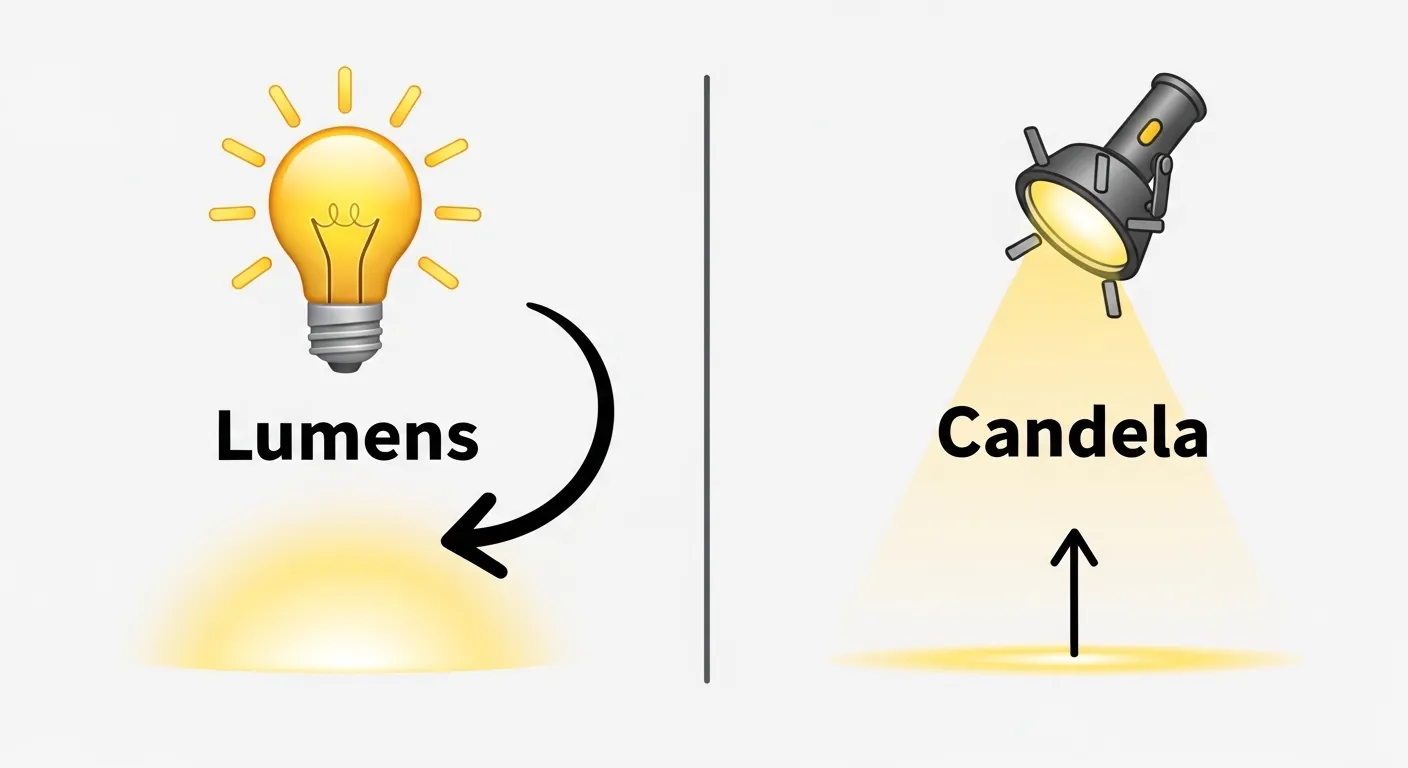
Imagine you want to buy a flashlight for camping. You see two numbers on the package: lumens and candela. At first glance, they both seem to measure brightness, so many people assume they mean the same thing. However, there is an important difference between lumens and candela.
Lumens measure the total amount of light produced by a source, while candela measure how intense the light is in a particular direction. Understanding the difference between lumens and candela helps consumers choose the right lighting products, engineers design efficient lamps, and students understand how light is measured. The difference between lumens and candela is especially important when selecting flashlights, car headlights, or stage lighting. Learning the difference between lumens and candela also improves knowledge of basic lighting science.
Key Difference Between the Two
The main difference is what they measure.
Lumens measure total light output, while candela measure light intensity in a specific direction.
Why Their Difference Is Necessary to Know
Knowing the difference is important for lighting design, photography, engineering, and everyday product selection. For example, a bulb with high lumens spreads light across a room, while a light with high candela focuses brightness into a narrow beam. Understanding the difference between lumens and candela helps consumers choose better lighting for homes, vehicles, and workplaces. In society, proper lighting improves safety, productivity, and energy efficiency.
Pronunciation (US & UK)
Lumens
- US: /ˈluː.mənz/
- UK: /ˈluː.mənz/
Candela
- US: /kænˈdiː.lə/
- UK: /kænˈdiː.lə/
Before moving deeper, let’s explore the detailed difference between lumens and candela.
Difference Between Lumens and Candela
1. Basic Definition
Lumens measure the total amount of visible light emitted by a source.
Candela measures the intensity of light in a particular direction.
Lumens Examples
- An 800-lumen LED bulb is lighting a room.
- A 2000-lumen camping lantern.
Candela Examples
- A focused flashlight beam rated at high candela.
- A lighthouse beam shining in one direction.
2. Type of Measurement
Lumens measure overall brightness output.
Candela measures directional brightness.
Lumens Examples
- The room ceiling lights spread light evenly.
- LED bulbs for home lighting.
Candela Examples
- Spotlights in theaters.
- Laser pointer beams.
3. Spread of Light
Lumens measure light in all directions combined.
Candela measures light in a single direction or angle.
Lumens Examples
- Light bulbs illuminating an entire room.
- Lanterns spreading light around a campsite.
Candela Examples
- Car headlights focusing forward.
- Searchlights pointing at distant objects.
4. Use in Lighting Products
Lumens are commonly used for household bulbs and lamps.
Candela is used for spotlights and directional lights.
Lumens Examples
- LED bulb labels in stores.
- Smart home lighting products.
Candela Examples
- Emergency signal lights.
- Stadium spotlights.
5. Measurement Focus
Lumens focus on the quantity of light.
Candela focuses on the intensity of light.
Lumens Examples
- A lamp producing 1500 lumens for bright rooms.
- Office lighting systems.
Candela Examples
- Tactical flashlight beams.
- Stage lighting beams.
6. Lighting Purpose
Lumens help measure general illumination.
Candela helps measure focused illumination.
Lumens Examples
- Bedroom ceiling lights.
- Classroom lighting.
Candela Examples
- Security spotlight beams.
- Theater stage lights.
7. Scientific Definition
Lumens measure luminous flux.
Candela measures luminous intensity.
Lumens Examples
- Total output of a light bulb.
- Light from a lantern.
Candela Examples
- Intensity of a spotlight beam.
- Directional lighting measurement.
8. Real-World Importance
Lumens help determine how bright a room will be.
Candela helps determine how far a beam will reach.
Lumens Examples
- Choosing lighting for a living room.
- Installing bright office lighting.
Candela Examples
- Choosing a long-distance flashlight.
- Airport runway lights.
9. Beam Angle Influence
Lumens remain the same regardless of beam angle.
Candela changes depending on beam focus.
Lumens Examples
- A bulb emitting light evenly.
- LED panels spreading light.
Candela Examples
- Narrow spotlight beams.
- Concentrated flashlight beams.
10. Everyday Understanding
Lumens answer the question “How much light is produced?”
Candela answers the question “How strong is the light in one direction?”
Lumens Examples
- Lighting a living room.
- Bright office lamps.
Candela Examples
- Flashlight beams used during rescue operations.
- Directional signal lights.
Nature and Behaviour
Lumens: Represent the total amount of light emitted from a source in all directions.
Candela: Represent the strength or intensity of light focused in a specific direction.
Why People Are Confused About Their Use
People often think lumens and candela mean the same thing because both describe brightness. However, lumens measure total light output, while candela measures directional intensity.
Table: Difference and Similarity Between Lumens and Candela
| Feature | Lumens | Candela | Similarity |
| Meaning | Total light output | Light intensity in a direction | Both measure light |
| Scientific term | Luminous flux | Luminous intensity | Units of illumination |
| Direction | All directions | Specific direction | Used in lighting science |
| Usage | Bulbs and room lighting | Spotlights and beams | Help design lighting |
| Function | Measures brightness quantity | Measures brightness strength | Important in lighting technology |
Which Is Better in What Situation?
Lumens (100 words)
Lumens are better when you need to know how bright a light source will make a room or space. For example, when buying bulbs for a house, office, or classroom, lumens indicate the overall brightness produced by the lamp. A higher lumen rating means more total light output. People often choose bulbs with 800–1600 lumens for normal home lighting. Lumens help determine how evenly light spreads across an area, making them useful for general illumination.
Candela (100 words)
Candela is better when measuring how powerful a light beam is in a particular direction. This is especially useful for flashlights, car headlights, and spotlights. A high candela rating means the beam is very concentrated and can travel farther. For example, searchlights and rescue flashlights rely on high candela values to illuminate distant objects. Candela measurements are important for focused lighting applications.
Use in Metaphors and Similes
Because these are scientific terms, metaphor use is rare, but they can appear in technical comparisons.
- “His idea shone like a high-lumen lamp.”
- “Her focus was sharp like a candela beam.”
Connotative Meaning
Lumens
- Neutral: Scientific measurement of light
- Positive: Brightness and illumination
Candela
- Neutral: Technical measurement of light intensity
- Positive: Precision and focus
Works in Literature
Because these are scientific terms, they mostly appear in scientific works:
- “Lighting Handbook” – Technical reference, IES, 2011
- “Introduction to Light and Lighting” – Educational book, Gary Steffy, 2002
Movies Related to Light and Science
- Interstellar – 2014, USA/UK
- The Martian – 2015, USA
Frequently Asked Questions
1. Are lumens brighter than candela?
They measure different aspects of brightness, so one is not “brighter” than the other.
2. Which is more important for flashlights?
Both are important, but candela determines beam distance.
3. Why do bulb packages show lumens instead of candela?
Because home lighting focuses on total brightness.
4. Can a light have high lumens but low candela?
Yes, if the light spreads widely instead of focusing.
5. Which unit is part of the SI system?
Candela is a base SI unit of luminous intensity.
How Both Are Useful for Surroundings
Lumens help provide comfortable lighting in homes and workplaces. Candela ensures focused lighting for safety, transportation, and emergency situations.
Final Words
Lumens and candela both measure light, but they describe different aspects. Lumens focus on total brightness, while candela focuses on directional intensity.
Conclusion
Understanding the difference between lumens and candela helps people make better decisions about lighting. Lumens measure the total amount of light produced by a source, while candela measures how intense that light is in a particular direction. Both units are important in lighting design, engineering, and everyday product selection. By learning the difference between lumens and candela, consumers and students can better understand how lighting works and choose the most suitable light sources for different environments.