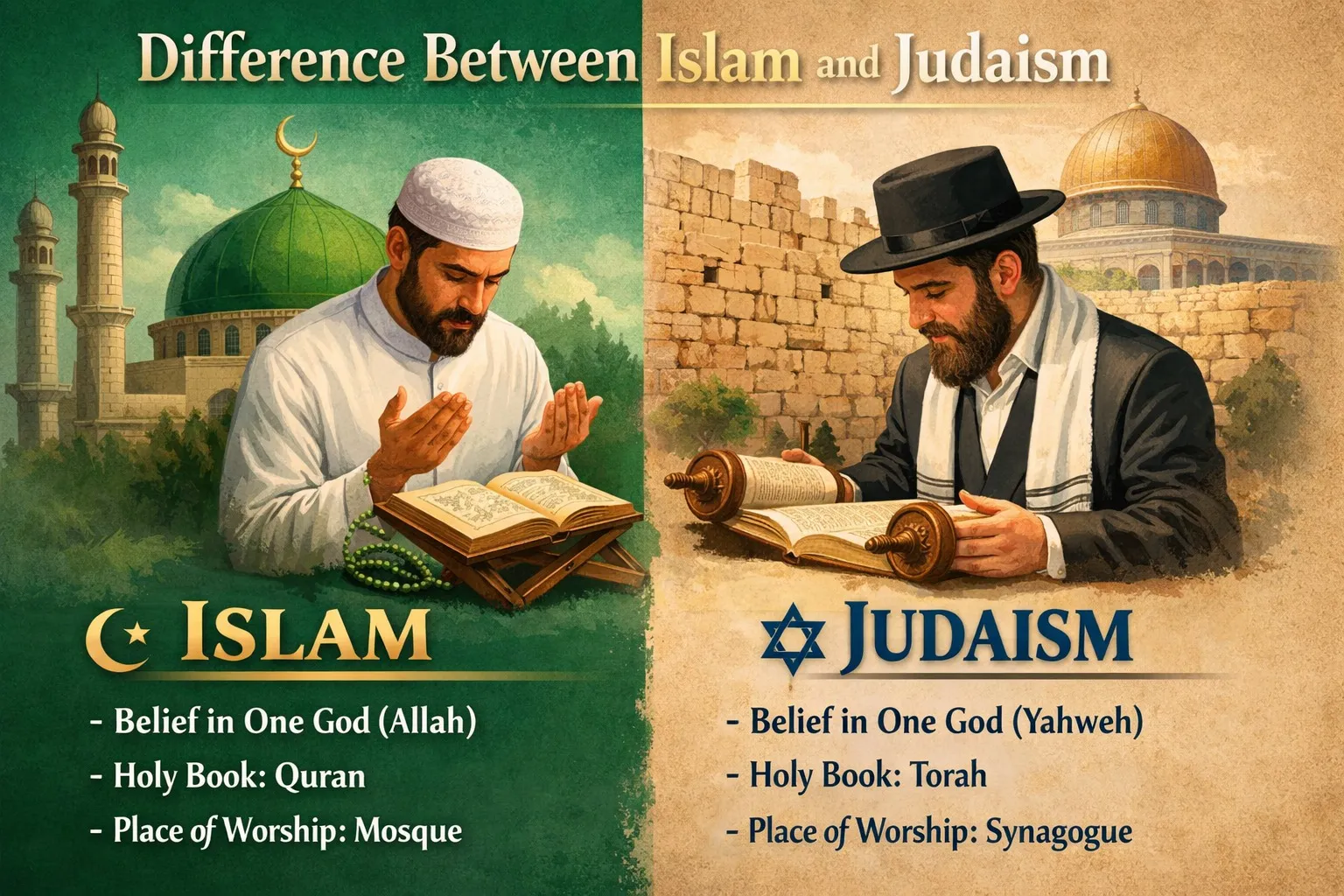
Islam and Judaism are two of the world’s oldest monotheistic religions, each with rich histories, traditions, and teachings. While both share the belief in one God and trace spiritual ancestry to Abraham, their rituals, holy texts, and practices differ significantly. For example, Islam follows the Quran and the teachings of Prophet Muhammad (PBUH), whereas Judaism follows the Torah and the guidance of rabbis. Understanding the difference between Islam and Judaism helps scholars, students, and the curious better appreciate religious diversity, theological beliefs, and cultural practices. Recognising these distinctions also promotes tolerance and interfaith dialogue.
Pronunciation
- Islam: US /ˈɪs.lɑːm/, UK /ˈɪs.lɑːm/
- Judaism: US /ˈdʒuː.deɪ.ɪ.zəm/, UK /ˈdʒuː.deɪ.ɪ.zəm/
Linking Hook: Let’s explore the main differences between Islam and Judaism, from beliefs and practices to holy texts and cultural traditions.
Difference Between Islam and Judaism
1. Founders
- Islam: Founded by Prophet Muhammad (PBUH) in the 7th century CE in Makkah.
- Example 1: Muhammad (saw) received revelations that became the Quran.
- Example 2: Islam spread rapidly across the Arabian Peninsula.
- Judaism: Rooted in the covenant between God and Abraham, developed over centuries.
- Example 1: Moses received the Torah at Mount Sinai.
- Example 2: Judaism evolved with laws, prophets, and rabbinic teachings.
2. Holy Texts
- Islam: Quran is the primary scripture; Hadith collections supplement teachings.
- Example 1: Quranic verses guide daily life, prayer, and law.
- Example 2: A hadith explains the Prophet Muhammad’s sayings and actions.
- Judaism: Torah (first five books of the Bible), Talmud, and other rabbinic texts.
- Example 1: Torah contains commandments and laws.
- Example 2: The Talmud provides commentary and interpretation.
3. Concept of God
- Islam: Strict monotheism (Tawhid), Allah is singular, omnipotent, and merciful.
- Example 1: God has no partners or equals.
- Example 2: Daily prayers emphasise submission to Allah.
- Judaism: Monotheism, Yahweh as one God; emphasis on covenant with the Jewish people.
- Example 1: God is the creator and lawgiver.
- Example 2: Jewish prayers stress obedience and remembrance of God.
4. Prophets
- Islam: Belief in many prophets, including Adam, Moses, Jesus, and Muhammad (the last prophet).
- Example 1: Muhammad is considered the last messenger of God.
- Example 2: The Quran recounts stories of previous prophets.
- Judaism: Belief in prophets like Moses, Isaiah, and Jeremiah; no prophet after the Torah.
- Example 1: Moses led the Israelites during the Exodus and received the Ten Commandments.
- Example 2: Prophets advised Israelite kings and communities.
5. Places of Worship
- Islam: Mosques for communal prayers.
- Example 1: Friday prayers (Jumu’ah) are obligatory for men.
- Example 2: Muslims face Mecca during prayers.
- Judaism: Synagogues for prayer and study.
- Example 1: Weekly Shabbat services on Friday evening and Saturday.
- Example 2: Torah scrolls are central to synagogue worship.
6. Religious Practices
- Islam: Five Pillars – Shahada (faith), Salah (prayer), Zakat (charity), Sawm (fasting), Hajj (pilgrimage).
- Example 1: Muslims fast during Ramadan.
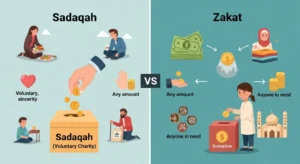
- Example 2: Zakat requires charitable giving.
- Judaism: Observances include Shabbat, dietary laws (Kosher), and festivals (Passover, Yom Kippur).
- Example 1: Shabbat observed with rest and prayer.
- Example 2: Kosher laws govern permitted foods.
7. Dietary Laws
- Islam: Halal – permissible foods; prohibition of pork and alcohol.
- Example 1: Meat must be slaughtered in a specific manner.
- Example 2: Alcohol consumption is forbidden.
- Judaism: Kosher – rules for food preparation and consumption.
- Example 1: Separation of meat and dairy.
- Example 2: Only certain animals are permissible.
8. Holidays
- Islam: Ramadan, Eid al-Fitr, Eid al-Adha.
- Example 1: Eid al-Fitr marks the end of fasting.
- Example 2: Eid al-Adha commemorates Abraham’s willingness to sacrifice.
- Judaism: Passover, Rosh Hashanah, Yom Kippur, Hanukkah.
- Example 1: Passover celebrates the Exodus from Egypt.
- Example 2: Yom Kippur is the Day of Atonement.
9. Views on Afterlife
- Islam: Belief in heaven (Jannah) and hell (Jahannam); deeds determine the outcome.
- Example 1: Righteous Muslims rewarded in paradise.
- Example 2: Sinners may face punishment.
- Judaism: Diverse views; focus on life on Earth, righteousness, and some belief in resurrection or Olam Ha-Ba (world to come).
- Example 1: Ethical living emphasized over afterlife reward.
- Example 2: Some Jewish traditions speak of resurrection of the dead.
10. Spread and Followers
- Islam: Second-largest religion; majority in Middle East, North Africa, South Asia.
- Example 1: Over 1.9 billion Muslims worldwide.
- Example 2: Predominant in countries like Saudi Arabia, Indonesia, and Pakistan.
- Judaism: Smaller global population; majority in Israel and USA.
- Example 1: About 15 million Jews worldwide.
- Example 2: Strong cultural and historical presence in Israel.
Nature and Behaviour
- Islam: Community-oriented, guided by Sharia, emphasizes charity, prayer, and submission to God.
- Judaism: Tradition-oriented, emphasizes study, ethical living, and covenantal relationship with God.
Why People Are Confused
Both religions are monotheistic, Abrahamic, and share some prophets and historical figures, which can lead to misconceptions about beliefs, practices, and laws.
Table: Difference and Similarity
| Feature | Islam | Judaism | Similarity |
| God | Allah, one and omnipotent | Yahweh, one God | Monotheistic religions |
| Holy Texts | Quran, Hadith | Torah, Talmud | Written guidance for life |
| Prophets | Muhammad (final prophet), others | Moses and other prophets | Both recognize Abrahamic lineage |
| Worship Place | Mosque | Synagogue | Both have communal worship spaces |
| Key Practices | Five Pillars | Shabbat, festivals, kosher | Rituals guide daily life |
Which is Better in What Situation?
Neither religion is “better”; both provide spiritual guidance, moral teachings, and community structure. Choice depends on personal belief, culture, and heritage.
Use in Metaphors and Similes
- Islam: “Faith flows like the five daily prayers, constant and unwavering.”
- Judaism: “Tradition is like the Torah scroll, central and guiding every step.”
Connotative Meaning
- Islam: Positive; devotion, submission, compassion.
- Judaism: Positive; heritage, ethics, learning.
Idioms or Proverbs
- “Patience is a virtue” – common in both religious teachings.
- “Do unto others as you would have them do unto you” – ethical principle shared in Abrahamic faiths.
Literature & Movies
- No God but God (Book, Reza Aslan, 2005) – Islam history and theology.
- The Chosen (Novel, Chaim Potok, 1967) – Judaism and coming-of-age story.
- The Message (Movie, 1976, Saudi Arabia) – Life of Prophet Muhammad.
- Fiddler on the Roof (Movie, 1971, USA) – Jewish culture and traditions.
FAQs
1. Are Islam and Judaism related?
Yes, both are Abrahamic and monotheistic religions.
2. Which religion is older?
Judaism predates Islam by thousands of years.
3. Do they share prophets?
Yes, prophets like Abraham and Moses are important in both religions.
4. Can someone practice both?
No, each has distinct beliefs and practices that require full commitment.
5. Are dietary laws similar?
Both have specific rules: Halal in Islam, Kosher in Judaism, but details differ.
How Both Are Useful for the Surroundings
Islam and Judaism provide moral guidance, community cohesion, charity, and ethical living, fostering social responsibility and spiritual well-being.
Final Words
Understanding the difference between Islam and Judaism enriches knowledge about religious diversity, promotes tolerance, and respects centuries-old traditions.
Conclusion
Islam and Judaism are both Abrahamic, monotheistic faiths with shared roots but distinct beliefs, practices, and holy texts. Islam emphasises the Quran, Prophet Muhammad, and Five Pillars, while Judaism centres on the Torah, covenant with God, and ethical living. Both religions have shaped cultures, laws, and societies, providing spiritual guidance, community, and ethical principles for millions worldwide. Appreciating their differences and similarities encourages understanding, respect, and interfaith harmony.