Imagine a scene from an adventure story where a warrior carries a small sharp weapon hidden in his belt. Sometimes the story calls it a knife, and sometimes it calls it a dagger. Many readers assume both words mean the same thing, but there is actually a clear difference between dagger and knife.
A knife is a common cutting tool used in kitchens, outdoor activities, and daily life. A dagger, however, is a specialized weapon designed mainly for stabbing and combat. Understanding the difference between dagger and knife helps readers, students, historians, and writers use the words correctly. The difference between dagger and knife is mainly based on design, purpose, and historical use. Learning the difference between dagger and knife also helps people understand how tools and weapons developed in different cultures.
Key Difference Between the Both
The main difference is their purpose and design.
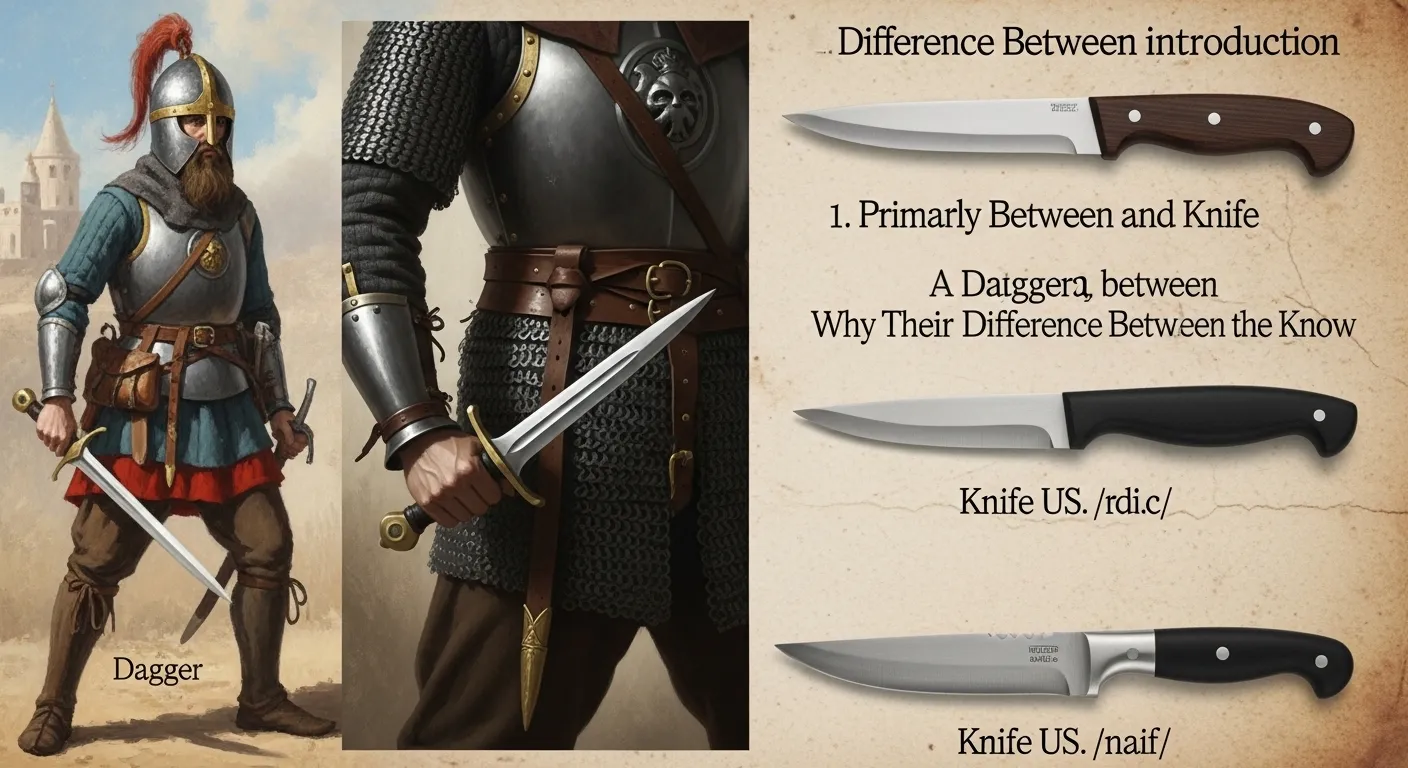
A knife is a general cutting tool used for many everyday tasks, while a dagger is primarily a double-edged weapon designed for stabbing.
Why Their Difference Is Necessary to Know
Understanding this difference is important for language learners, historians, and writers. In literature, films, and historical texts, the correct term changes the meaning of a scene. For example, a chef uses a knife, while a medieval soldier might carry a dagger. Knowing the difference between dagger and knife improves vocabulary accuracy and helps people describe tools, weapons, and historical objects correctly. In society, clear terminology also helps in education, archaeology, and museum documentation.
Pronunciation (US & UK)
Dagger
- US: /ˈdæɡ.ɚ/
- UK: /ˈdæɡ.ə/
Knife
- US: /naɪf/
- UK: /naɪf/
Before exploring further, let’s examine the detailed difference between dagger and knife through clear comparison points.
Difference Between Dagger and Knife
1. Primary Purpose
A dagger is mainly a weapon for stabbing in combat.
A knife is a multipurpose cutting tool.
Dagger Examples
- A medieval soldier carrying a dagger for close combat.
- A ceremonial dagger used in historical rituals.
Knife Examples
- A kitchen knife used for chopping vegetables.
- A camping knife used for cutting rope or food.
2. Blade Design
Daggers usually have double-edged blades.
Knives usually have a single cutting edge.
Dagger Examples
- Symmetrical blade sharpened on both sides.
- Slim blade designed to pierce armor gaps.
Knife Examples
- Chef’s knife with one sharp side.
- Pocket knife with a single cutting edge.
3. Shape
Daggers are narrow and pointed.
Knives come in many shapes and sizes.
Dagger Examples
- Thin triangular blade.
- Straight, balanced weapon.
Knife Examples
- Curved kitchen knife.
- Folding pocket knife.
4. Historical Use
Daggers were commonly used in warfare and self-defense.
Knives were used for domestic and practical tasks.
Dagger Examples
- Used by knights in medieval battles.
- Hidden weapon carried by guards.
Knife Examples
- Farmers using knives to cut crops.
- Hunters using knives for skinning animals.
5. Blade Length
Daggers often have shorter but sharper blades.
Knives can vary widely in blade length.
Dagger Examples
- Short combat blade.
- Compact concealed weapon.
Knife Examples
- Small fruit knife.
- Large butcher knife.
6. Everyday Use
Daggers are rarely used in daily life today.
Knives are common household tools.
Dagger Examples
- Museum artifact.
- Collectible weapon.
Knife Examples
- Kitchen cooking tool.
- Utility tool for outdoor activities.
7. Cultural Role
Daggers often symbolize power or bravery.
Knives symbolize practicality and work.
Dagger Examples
- Traditional ceremonial dagger in cultural dress.
- Symbol of honor in ancient societies.
Knife Examples
- Tool of a chef.
- Household cutting instrument.
8. Carrying Method
Daggers are usually carried in a sheath as a weapon.
Knives may be stored in drawers, toolkits, or pockets.
Dagger Examples
- Belt-mounted sheath.
- Hidden under clothing.
Knife Examples
- Kitchen drawer storage.
- Folding knife in a pocket.
9. Safety and Regulation
Daggers are often restricted because they are weapons.
Knives are generally allowed as tools.
Dagger Examples
- Controlled weapon in many countries.
- Restricted in public places.
Knife Examples
- Cooking knives used at home.
- Utility knives for crafts.
10. Symbolism in Stories
Daggers are often associated with betrayal or assassination.
Knives are associated with work or survival.
Dagger Examples
- Secret attack in a historical drama.
- Symbol of betrayal in literature.
Knife Examples
- Tool for preparing food during travel.
- Survival tool in adventure stories.
Nature and Behaviour
Dagger: Aggressive, symbolic weapon designed for piercing.
Knife: Practical, versatile tool used for cutting tasks in daily life.
Why People Are Confused About Their Use
People confuse them because both have blades and look similar. In everyday language, people often call any small blade a knife. However, historically and technically, a dagger has a specific design and combat purpose.
Table: Difference and Similarity Between Dagger and Knife
| Feature | Dagger | Knife | Similarity |
| Purpose | Weapon | Tool | Both have blades |
| Blade Edge | Double edged | Usually single edged | Used for cutting or piercing |
| Shape | Narrow and pointed | Many shapes | Handheld tools |
| Usage | Combat or ceremonial | Everyday tasks | Require careful handling |
| Popularity | Rare today | Very common | Made of metal blades |
Which Is Better in What Situation?
Dagger (100 words)
A dagger is better suited for historical combat situations or ceremonial symbolism. In ancient times, soldiers used daggers as backup weapons when swords were not practical. Their narrow and double-edged blades allowed quick stabbing in close combat. Today, daggers are mostly used for display, collections, cultural ceremonies, or historical reenactments. They are rarely used as everyday tools because their design focuses more on piercing than cutting.
Knife (100 words)
A knife is better for everyday activities such as cooking, camping, crafting, and general cutting tasks. In kitchens, knives help prepare food efficiently. Outdoors, knives are useful for survival tasks like cutting rope, preparing food, or carving wood. Because knives come in many shapes and sizes, they are one of the most versatile tools humans use. Their practical design makes them suitable for daily work rather than combat.
Use in Metaphors and Similes
- “Her words were like a dagger to his heart.” (deep emotional hurt)
- “The cold wind cut like a knife.” (very sharp or painful feeling)
Connotative Meaning
Dagger
- Positive: Courage, honor in warrior culture
- Negative: Betrayal or violence
- Neutral: Historical weapon
Knife
- Positive: Practicality and skill (chef’s knife)
- Neutral: Everyday tool
- Slight Negative: Danger if misused
Idioms or Proverbs
“At daggers drawn” – in extreme anger or conflict
Example: The two leaders were at daggers drawn during the meeting.
“Twist the knife” – make a painful situation worse
Example: He twisted the knife by reminding her of the mistake.
“Knife-edge decision” – a very close outcome
Example: The match ended in a knife-edge decision.
Works in Literature
- “Macbeth” – Tragedy, William Shakespeare, 1606 (famous dagger hallucination scene)
- “The Knife of Never Letting Go” – Science fiction novel, Patrick Ness, 2008
Movies Related to Knife or Dagger
- Knives Out – 2019, USA
- The Man with the Golden Gun – 1974, UK/USA (features ceremonial dagger imagery)
Frequently Asked Questions
1. Is a dagger a type of knife?
Some experts consider it a specialized form of knife designed mainly for stabbing.
2. Why does a dagger have two edges?
Two edges make stabbing more effective from different angles.
3. Are kitchen knives considered daggers?
No, because they are designed for cutting food, not combat.
4. Which came first historically?
Simple knives appeared earlier as tools; daggers developed later as weapons.
5. Are daggers still used today?
Mostly for ceremonial, decorative, or historical purposes.
How Both Are Useful for Surroundings
Knives are essential for cooking, crafts, and survival tasks. Daggers have historical, cultural, and symbolic importance. Together, they represent how tools evolved into specialized instruments.
Final Words
While both have blades and handles, their purpose makes them different. Knives are everyday tools, while daggers are specialized weapons.
Conclusion
Understanding the difference between dagger and knife helps people use language more precisely and appreciate historical tools. A knife is a versatile tool used in daily life for cutting tasks, while a dagger is primarily a weapon designed for stabbing and combat. Although they share similar structures, their design, purpose, and cultural roles differ significantly. Recognizing these distinctions helps students, readers, historians, and writers communicate clearly and understand the evolution of tools and weapons across civilizations.