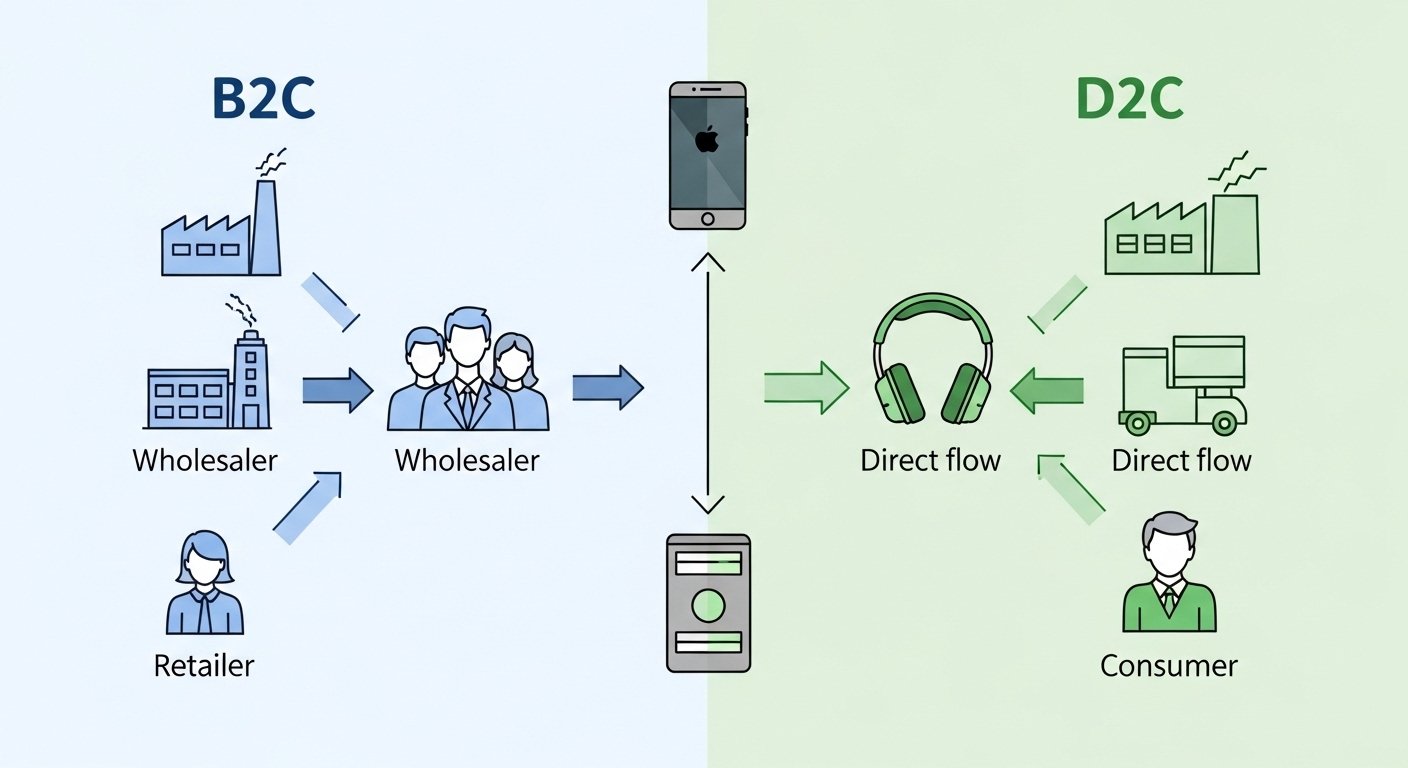
Imagine a toy company that makes toys and sends them to a big store. The store then sells the toys to customers. This is called B2C. In B2C, a business sells products to customers, but sometimes there is a shop or middleman between them.
Now imagine another toy company that sells toys directly to customers using its own website. There is no middle shop. The company makes the toy and sells it straight to the buyer. This is called D2C.
The difference between B2C and D2C is simple but important. In B2C, a business sells products to customers through stores or platforms. In D2C, a company sells its products directly to customers. Learning the difference between B2C and D2C helps students understand how modern online businesses work. The difference between B2C and D2C also helps new entrepreneurs decide how they want to sell their products. Knowing the difference between B2C and D2C makes the idea of digital business easier to understand.
Key Difference Between the Two
The main difference between B2C and D2C is the middle seller.
- In B2C, a business sells to customers, often through retailers or marketplaces.
- In D2C, the company sells directly to the customer without a middle seller.
Why Their Difference Is Important for Learners and Experts
Knowing the difference between B2C and D2C helps people understand how businesses sell products today. Students learn how products reach buyers, and experts choose better ways to sell goods.
In society, B2C helps big stores and marketplaces grow. D2C helps companies connect directly with customers and build strong brands.
Pronunciation
B2C
US: bee-two-see
UK: bee-two-see
D2C
US: dee-two-see
UK: dee-two-see
Linking Hook
Now that we know the meaning of these two terms, let us explore the difference between B2C and D2C in simple points.
Difference Between B2C and D2C
1. Selling Method
B2C:
A business sells to customers through a store or platform.
Examples:
- A company sells shoes through an online marketplace.
- A brand sells clothes in a big shopping mall.
D2C:
A company sells directly to customers.
Examples:
- A brand sells shoes on its own website.
- A clothing company sells directly through its app.
2. Middleman
B2C:
There may be a middle seller.
Examples:
- Retail stores selling brand products.
- Online marketplaces selling company items.
D2C:
There is no middle seller.
Examples:
- Company website selling its own product.
- Brand-owned online store.
3. Customer Relationship
B2C:
The store often deals with customers.
Examples:
- Customer asks the retailer for help.
- Store manages returns.
D2C:
The company talks directly with customers.
Examples:
- Company answers questions.
- Brand handles refunds itself.
4. Profit
B2C:
Profit is shared with retailers.
Examples:
- Store takes a percentage of sales.
- Marketplace charges a selling fee.
D2C:
Company keeps more profit.
Examples:
- Selling products on its own website.
- No retailer commission.
5. Branding
B2C:
Brand control may be smaller.
Examples:
- Products displayed with many other brands.
- Limited control in retail stores.
D2C:
Brand control is stronger.
Examples:
- Custom website design.
- Unique packaging.
6. Product Price
B2C:
Prices may include retailer costs.
Examples:
- Store adds extra profit margin.
- Marketplace service fees.
D2C:
Prices may be lower.
Examples:
- No retailer commission.
- Direct company pricing.
7. Marketing
B2C:
Retail stores also promote products.
Examples:
- Store advertisements.
- Marketplace promotions.
D2C:
Company does its own marketing.
Examples:
- Social media ads.
- Email marketing.
8. Customer Data
B2C:
Retailers keep most customer data.
Examples:
- Store collects buyer information.
- Marketplace tracks customers.
D2C:
Company collects customer data directly.
Examples:
- Website customer accounts.
- Direct feedback from buyers.
9. Shopping Experience
B2C:
Customers shop in stores or marketplaces.
Examples:
- Buying from a retail shop.
- Buying from an online marketplace.
D2C:
Customers shop from the brand itself.
Examples:
- Brand website store.
- Brand mobile app.
10. Business Growth
B2C:
Growth may depend on retailers.
Examples:
- Expanding to more stores.
- Partnering with new marketplaces.
D2C:
Growth depends on the brand’s own marketing.
Examples:
- Building a strong website.
- Growing social media followers.
Nature and Behaviour of Both
B2C is a traditional way of selling where businesses often work with retailers or marketplaces.
D2C is a modern model where brands connect directly with customers using websites and social media.
Why People Are Confused
People get confused because D2C is also part of B2C. Both involve selling products to customers, but D2C removes the middle seller.
Table: Difference and Similarity
| Feature | B2C | D2C | Similarity |
| Selling | Through retailers | Directly from brand | Both sell to customers |
| Middleman | Often present | Not present | Both sell products |
| Profit | Shared with retailer | Mostly kept by company | Both earn money |
| Customer contact | Store interacts | Brand interacts | Both serve customers |
Which Is Better in What Situation?
B2C is better when a company wants to sell products in many stores quickly. Retailers and marketplaces help businesses reach many customers.
D2C is better when a company wants strong control over its brand and customer experience. It helps businesses build direct relationships with buyers.
Metaphors and Similes
- B2C is like selling products through a big supermarket.
- D2C is like selling products directly from your own shop.
Connotative Meaning
B2C
Positive: traditional business system
Neutral: selling to customers
Negative: less control over customers
Example:
“Many companies use B2C to sell through retailers.”
D2C
Positive: modern and direct business model
Neutral: direct selling system
Negative: requires strong marketing
Example:
“D2C helps brands talk directly to customers.”
Idioms or Proverbs
1. The middleman takes a cut.
Example: In B2C, retailers take a share of the profit.
2. Cut out the middleman.
Example: D2C brands sell directly to customers.
Works in Literature
- The Everything Store – Brad Stone (Business book, 2013)
- The Lean Startup – Eric Ries (Business book, 2011)
Movies Related to Online Business
- The Social Network (2010, USA)
- Startup.com (2001, USA)
Frequently Asked Questions
1. What does B2C mean?
B2C means Business to Customer.
2. What does D2C mean?
D2C means Direct to Customer.
3. Which model is more modern?
D2C is considered more modern.
4. Do both sell products to customers?
Yes, both sell to customers.
5. Which one gives more control to brands?
D2C gives more control to brands.
How Both Are Useful for Surroundings
B2C helps stores, retailers, and marketplaces grow. D2C helps companies build direct relationships with customers and create new online businesses.
Final Words for Both
B2C and D2C are both ways companies sell products to customers. The main difference is whether a middle seller is involved or not.
Conclusion
The difference between B2C and D2C mainly depends on how products reach customers. In B2C, businesses often sell through retailers or marketplaces. In D2C, companies sell directly to customers without a middle seller. Both models are important in modern business. B2C helps companies reach many customers quickly through stores and marketplaces. D2C allows brands to control their products, prices, and customer relationships. Understanding the difference between B2C and D2C helps students, entrepreneurs, and business learners understand how online and modern businesses work.