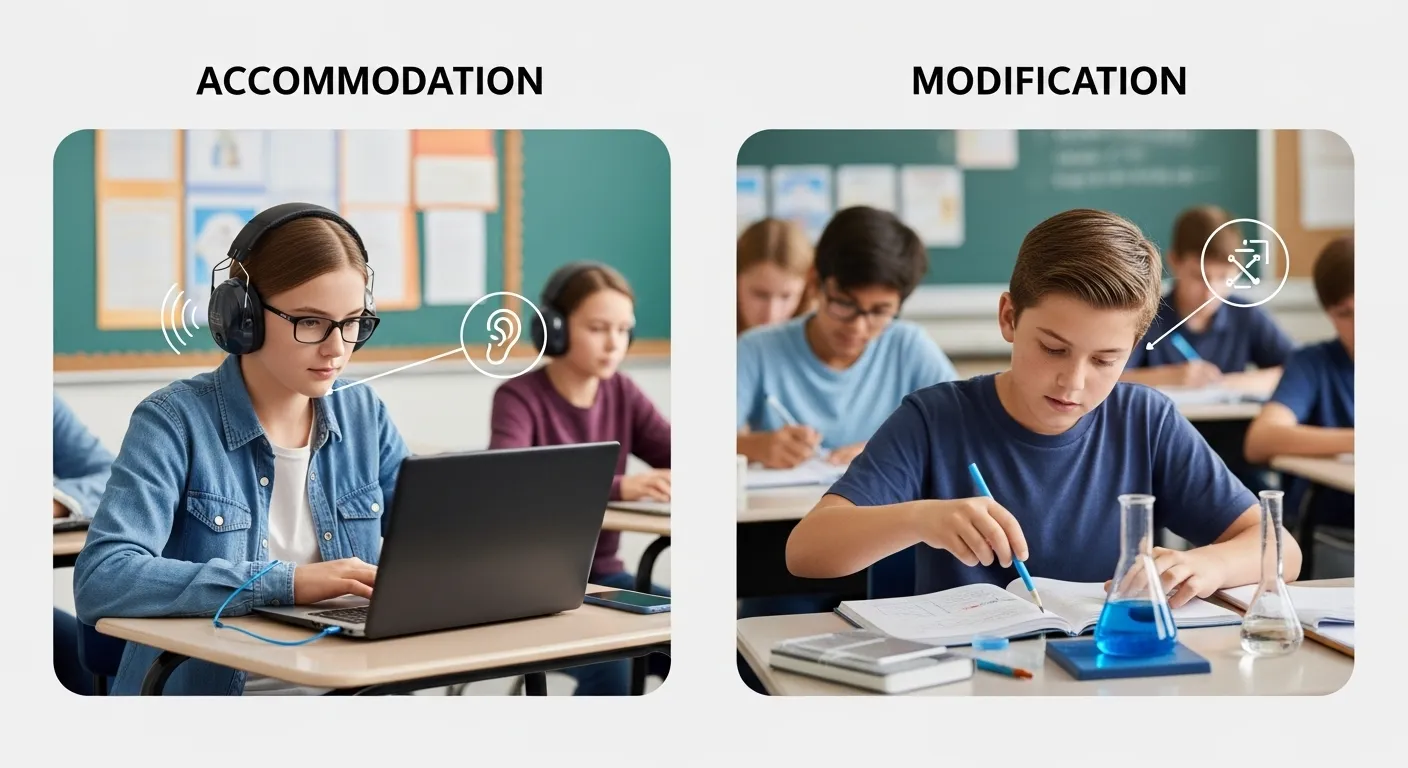
Imagine a student named Sara who struggles with reading due to dyslexia. Her teacher provides her with extra time on exams and audiobooks to complete assignments. Here, Sara is receiving accommodation. In another class, the teacher simplifies the curriculum and reduces the number of tasks to match her learning needs. This is called modification. Understanding the difference between accommodation and modification is crucial for teachers, parents, and students. While both aim to support learning, they work in different ways. Knowing the difference between accommodation and modification helps educators plan effective strategies and ensures students achieve their potential.
The difference between accommodation and modification lies in approach: accommodations adjust how students learn or demonstrate knowledge, while modifications change what students are expected to learn.
Pronunciation (US & UK)
- Accommodation
- US: /əˌkɑː.məˈdeɪ.ʃən/
- UK: /əˌkɒm.əˈdeɪ.ʃən/
- Modification
- US: /ˌmɑː.də.fəˈkeɪ.ʃən/
- UK: /ˌmɒd.ɪ.fɪˈkeɪ.ʃən/
Before diving deeper, let’s explore the detailed difference between accommodation and modification.
Difference Between Accommodation and Modification
1. Definition
- Accommodation: Adjusting how a student learns without changing learning expectations.
- Modification: Changing what a student is expected to learn.
Accommodation Example: Extra time on a test.
Modification Example: Reducing reading assignments.
2. Purpose
- Accommodation supports access to learning.
- Modification changes learning goals to fit the student’s level.
Accommodation Example: Using a calculator in math class.
Modification Example: Learning only basic math operations instead of advanced ones.
3. Effect on Curriculum
- Accommodation does not alter the curriculum.
- Modification alters the curriculum content.
Accommodation Example: Providing audio versions of a textbook.
Modification Example: Shortening chapters or skipping topics.
4. Impact on Assessment
- Accommodation allows students to show knowledge differently.
- Modification changes the expected performance level.
Accommodation Example: Oral presentation instead of written essay.
Modification Example: Grading based on fewer questions or simplified criteria.
5. Who Uses It?
- Accommodation is for students with mild to moderate needs.
- Modification is for students with significant needs.
Accommodation Example: Extra time for ADHD students.
Modification Example: Simplified reading material for severe learning disabilities.
6. Legal Basis
- Accommodation is often legally required under IDEA and ADA.
- Modification may or may not be legally required but is recommended for Individualized Education Programs (IEPs).
Accommodation Example: Accessible classroom technology.
Modification Example: Custom IEP goals.
7. Type of Support
- Accommodation changes the learning process.
- Modification changes the learning outcome.
Accommodation Example: Large print books.
Modification Example: Learning simpler concepts than peers.
8. Frequency of Use
- Accommodation is commonly used in regular classrooms.
- Modification is less frequent and used when accommodation is insufficient.
Accommodation Example: Allowing breaks for students during exams.
Modification Example: Reducing test length or difficulty.
9. Complexity
- Accommodation is simpler to implement.
- Modification requires planning and curriculum changes.
Accommodation Example: Sitting in front row for better visibility.
Modification Example: Creating alternative assignments for a subject.
10. Outcome
- Accommodation helps students meet the same standard as peers.
- Modification sets different expectations tailored to abilities.
Accommodation Example: Student completes the same math test with extra time.
Modification Example: Student completes a simplified version of the test.
Nature and Behaviour
Accommodation: Inclusive, flexible, focuses on access.
Modification: Adaptive, individualized, focuses on success by adjusting expectations.
Why People Are Confused
Many educators and parents confuse them because both aim to support learning. The key difference is process vs. outcome—accommodation adjusts methods, modification adjusts expectations.
Table: Difference and Similarity Between Accommodation and Modification
| Feature | Accommodation | Modification | Similarity |
| Definition | Changes how a student learns | Changes what a student learns | Both support student learning |
| Curriculum | Same | Altered | Improve learning access |
| Assessment | Adjusted method | Adjusted level | Help students succeed |
| Frequency | Common | Less common | Used in schools |
| Outcome | Same standard | Different standard | Improve performance |
Which Is Better in What Situation?
Accommodation: Best for students who can meet grade-level standards with extra help or tools. Example: Extra time for exams or use of assistive technology.
Modification: Best for students who cannot meet grade-level standards even with accommodations. Example: Simplifying assignments or setting personalized learning goals.
Use in Metaphors and Similes
- “Accommodation is like adding ramps to a building; it helps everyone enter without changing the structure.”
- “Modification is like remodeling a room; the space itself changes to meet needs.”
Connotative Meaning
Accommodation: Positive (supportive), Neutral (adjustment).
Modification: Positive (adaptive), Neutral (change), Slight Negative (less challenging than peers).
Idioms or Proverbs
- “Bend over backward.” Example: Teachers bend over backward to accommodate students.
- “Cutting some slack.” Example: Modification allows teachers to cut some slack for struggling learners.
Works in Literature
- “Teaching Students with Learning Disabilities” – Book, Cecil Mercer, 2010
- “Special Education: Principles and Practices” – Book, Hallahan & Kauffman, 2012
Frequently Asked Questions
1. Are accommodation and modification legally required?
Accommodations often are; modifications depend on student needs and IEP.
2. Can a student use both?
Yes, some students require both depending on tasks.
3. Does modification lower expectations?
Yes, it adjusts goals to the student’s ability.
4. Is accommodation easier to implement?
Generally, yes; it requires fewer changes to curriculum.
5. Can technology assist both?
Yes, tools like screen readers or simplified apps support both.
How Both Are Useful for Surroundings
Accommodations ensure students access mainstream education. Modifications ensure students with significant challenges succeed, contributing to inclusive communities.
Final Words
Both accommodation and modification are essential in education. They empower students, reduce barriers, and promote equitable learning. Choosing the right approach depends on the student’s needs and goals.
Conclusion
The difference between accommodation and modification lies in approach: accommodations adjust how students learn, modifications adjust what they learn. Both strategies improve student engagement, inclusion, and success. Educators, parents, and learners benefit from understanding these differences to provide tailored support. Awareness of these concepts strengthens education systems and ensures no student is left behind, creating an inclusive and supportive learning environment.